Chasing Flying Saucers Made Me A Better Thinker
What I learned from a childhood obsession with the impossible
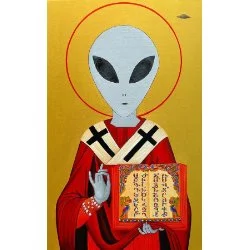
As a child I would stay up all night, reading books like Chariots of the Gods, Erich von Däniken’s book that popularized the “ancient astronaut” theory of extraterrestrials who meddled in paleo-human affairs. Later, I collected UFO books with names like The UFO Cover-Up, Above Top Secret, anything with a flying saucer on the cover. I videotaped documentaries about Area 51. I drew pictures of gray aliens during math class.
I wasn’t looking for entertainment. I was hunting for “The Truth” with the capital letters that only a young dramatist can muster. UFOs became my obsession because they promised answers to the biggest questions: Are we alone? What’s really going on? Who’s hiding what from us? Questions that I was asking more about my own life, I now understand in retrospect.
For over a decade, I built an elaborate mental architecture around UFO phenomena. Every new book and blurry photograph fed my growing certainty about what was “really” happening. I wanted desperately to either prove UFOs were extraterrestrial spacecraft or debunk them completely. Those felt like the only two options.
Then I discovered Jacques Vallée and my thinking changed. Not because I figured out what UFOs are, but because I stopped trying to.
Jacques Vallée, the French computer scientist who helped design the early internet and has spent seventy years studying UFO reports, approached the phenomenon differently than anyone I’d encountered. He wasn’t trying to prove or disprove anything. He was studying patterns. The character Lacombe in Close Encounters of the Third Kind is based on him. But Spielberg couldn’t capture Vallée’s most radical insight. Maybe the wrong question isn’t “What are UFOs?” Maybe the right question is “What do UFO experiences do to people?”
Around the same time, I found Robert Anton Wilson’s Cosmic Trigger, which introduced me to “reality tunnels,” the idea that we all live inside our own constructed versions of reality, mistaking our constructs for reality itself. Wilson wasn’t interested in whether UFOs were real. He was interested in how belief shapes experience and how experience shapes belief.
These two thinkers didn’t make me more certain about UFOs. They made me less certain about everything. And that uncertainty became the foundation of how I approach complex problems today.
The most striking thing about UFO reports is their trickster-like quality. They appear just long enough to be noticed, then vanish before definitive proof can be gathered. They seem to adapt to our cultural moment. Angels and demons in antiquity. Fairy folk in medieval times. Airships in the 1890s. Spaceships in the 1950s. AI-controlled drones today.
This pattern initially frustrated me. Why couldn’t the phenomenon just be straightforward? Then I realized the ambiguity was the teacher. UFOs exist at the threshold of believability, forcing us to grapple with uncertainty rather than settling into comfortable conclusions.
The phenomenon became my training ground for holding contradictory possibilities simultaneously. How do you act decisively while acknowledging you might be completely wrong? How do you stay curious without becoming gullible? How do you question reality without losing your mind?
These questions proved far more valuable than solving the UFO mystery ever could have been.
When I started working in the music industry, I kept encountering the same either/or thinking that had trapped my UFO pursuit. You were either an “artist person” or a “businessperson.” You either preserved artistic purity or you compromised for commercial success. You either trusted your gut or you relied on data.
Binary thinking is a trap. Reality is usually messier than our categories suggest. Multiple explanations can be and usually are simultaneously true. What looks like a simple either/or choice often reveals itself as a more interesting both/and situation.
I came to learn that business itself can be creative, that the most interesting work happens at the intersection of different domains, that you can be commercially successful while maintaining artistic integrity. I needed strong opinions to advocate for a creative vision, to push back against shortsighted decisions, to guide projects through chaos. But I also needed to hold those opinions lightly enough to adapt when new information emerged, when visions evolved, when markets shifted.
This became my approach to everything: form strong working hypotheses while remaining genuinely open to being completely wrong.
Over the past thirty years working across music, technology, and media, I’ve noticed that the most interesting opportunities emerge in ambiguous situations. When you can’t rely on simple answers, you get better at navigating complexity.
When mp3s emerged in the late ’90s, the industry faced a classic UFO-like phenomenon. Something was happening. Nobody could agree on what it meant. Was it the end of the music industry or the beginning of something new? The people who thrived were those who could hold multiple possibilities in mind simultaneously, understanding that it could devastate traditional revenue streams and create new opportunities for artists to reach audiences.
The same pattern repeated with streaming, social media, AI. Each time, the people who got stuck in binary thinking, those advocating either complete acceptance or total rejection, missed the nuanced reality unfolding.
Sometimes the most practical tools come from the most unexpected places. A childhood obsession with flying saucers became my framework for thriving in an uncertain world. Not because I figured out what UFOs are, but because I learned to be okay with not knowing. As the world gets more complex and the pace of change accelerates, the most useful skill is not having the right answers, it is being comfortable with uncertainty while still taking decisive action.
The phenomenon remains as mysterious as ever, and chasing it continues to teach me how to think.
But Don’t Take My Word For It
Jacques Vallée’s Alien Contact trilogy, the books Dimensions, Confrontations, and Revelations, offers the most sophisticated analysis of how anomalous phenomena can serve as a lens for understanding consciousness, culture, and the limitations of our current paradigms.
Robert Anton Wilson’s Cosmic Trigger is a mind-expanding exploration of reality tunnels, consciousness, and the art of maybe, written with humor, vulnerability, and intellectual fearlessness.
Diana Pasulka’s American Cosmic is a scholarly yet engaging look at how encounters with anomalous phenomena intersect with technology, belief, and academic culture. I interviewed Diana in 2023.