Green Is Their Color
The coincidence that does not behave like one.
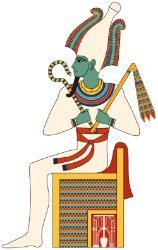
In ancient Egypt, Osiris, god of death, resurrection, and the afterlife, was depicted with green skin. For the people of the Nile Valley, green was the color of rebirth, of vegetation returning after the river’s annual flood. Green was also the color of the mineral malachite, which the Egyptians used in cosmetics and to decorate funerary items. To them, green was not the color of life as opposed to death. Green was the color of what survives death. The afterlife, or eternal life.
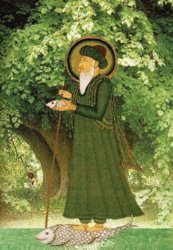
In the Quran, Al-Khidr (“the Green One”) is an enigmatic immortal who appears to Moses and teaches him through a series of actions that seem destructive or irrational until their hidden wisdom is revealed. Islamic scholarship has debated what Al-Khidr actually is for over a thousand years: prophet, angel, saint, something else entirely. No consensus. What is agreed is his color and what it signifies. Green in Islam is the color of paradise, of the Prophet’s cloak, of divine knowledge. Al-Khidr’s greenness marks him as a carrier of esoteric wisdom, knowledge that comes not from study or prophecy but directly from God’s own presence: what the tradition calls ilm al-ladunni, knowledge from the divine itself. There are scholars and mystics who believe he is still alive today, and who have claimed to have seen him.
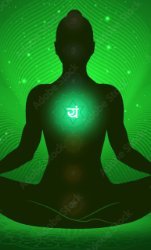
In the Hindu and Buddhist tantric systems, the heart chakra, Anahata, is green. It sits at the center of the body’s energy system, bridging the lower physical chakras and the upper spiritual ones. It is the seat of compassion, balance, and direct knowing. The associated element is air, which moves freely in all directions. Anahata is described as the point where matter and consciousness meet, the location of an inner sound that can be heard only when the mind becomes still enough. Green again, and again at the boundary between the material and the immaterial.
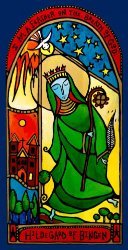
In twelfth-century Germany, the Benedictine abbess Hildegard von Bingen built an entire theology around a concept she called viriditas, literally “greenness” or “greening power.” For Hildegard, viriditas was the divine force animating all living things, the visible signature of God’s creative energy moving through the material world. She wrote that human flesh is green, that our blood possesses this greening power, that the life force of the soul itself is green. When viriditas flows, there is health, creativity, and spiritual vitality. When it is blocked, there is spiritual and physical decay. Hildegard was a Christian mystic who likely had no access to sources of scholarship about Islamic esoteric literature, no knowledge of the Hindu chakra system, and no exposure to Egyptian funerary theology. Yet, green
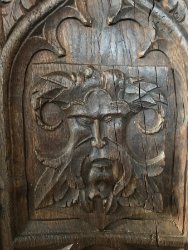
In European folk tradition, the Green Man (a face made of or surrounded by leaves, often with foliage spilling from the mouth) appears carved into medieval churches across the continent. The figure predates its Christian context. The motif is traced to India, from where it traveled through the medieval Arab world into European architecture. The Green Man represents the cycle of growth, death, and renewal: nature’s refusal to stay dead. He keeps showing up in the stonework of cathedrals built by people who officially worshiped a resurrected God, which is either a remarkable tolerance or an acknowledgment that the green figure and the resurrection story are telling us about at the same thing.
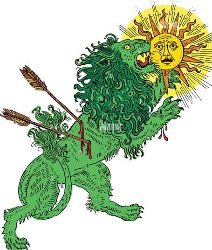
In alchemy, the Western esoteric tradition most concerned with transformation, green appears as a critical stage marker. The viriditas of the alchemical process, the “green lion,” represents the raw living force that must be encountered before transformation can occur. It is dangerous and necessary. It is the point at which the material being worked on shows its first sign of life.

Running alongside all of these, largely unnoticed by the scholars cataloguing the esoteric traditions, is a continuous folk tradition of green otherworldly beings in European culture. Sprites. Pixies. The faerie folk of Celtic and Germanic lore. Leprechauns. These are all green, and they all share the same characteristics: they exist between worlds, they possess knowledge humans don’t, they operate by rules that seem irrational until you understand their logic, they can help or harm depending on how you approach them, and contact with them changes you. The leprechaun of Irish folk tradition, not the cartoon on the cereal box but the original figure, was a solitary faerie who possessed hidden treasure and secret knowledge, who could only be engaged through trickery or by catching him off guard, and who vanished the moment you broke the terms of engagement. He was dangerous, not cute. And he was green. Jacques Vallée made the argument decades ago that the faerie encounters of medieval and early modern Europe are structurally identical to modern UFO contact reports. Same phenomenology, different cultural clothing.

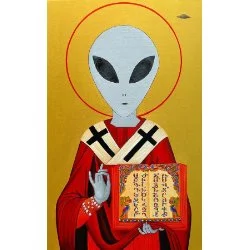
When UFO contact reports entered American popular culture in the 1950s, the entities were almost immediately coded green. “Little green men” became the shorthand, despite the fact that witnesses more often described the beings as silver or grey. The culture reached for green anyway, the color that every tradition listed above assigned to beings who operate between worlds, carry hidden knowledge, and exist outside normal human categories. The little green men of the UFO era aren’t a new association. They’re the latest iteration of an older, maybe the oldest, one.
Across the traditions touched on here, green is consistently attached to the same cluster of meanings: the boundary between life and death, the force that survives or overcomes death, hidden or esoteric knowledge, direct experiential knowing as opposed to doctrinal or rational knowledge, the liminal figure who operates between worlds, and the vital energy that animates living things from within.
That is a very specific semantic bundle to independently reinvent across all of these unrelated contexts and five thousand years. You might argue that a semantic bundle that specific is not a bundle. You might arguer that it’s a portrait.

It is interesting to absorb what the traditions are actually describing when read as accounts of the same encounter. A non-human intelligence. Green. Immortal or at least not bound by normal human time. In possession of knowledge that cannot be obtained through ordinary means. Teaching through methods that appear irrational or destructive until their hidden logic is revealed. Accessible only to those who meet it on its own terms. Dangerous if you get the protocol wrong. Transformative if you get it right.
Al-Khidr does this with Moses. Osiris does this with the dead. The faerie folk do this with anyone foolish or brave enough to engage. The leprechaun does this with the one who catches him. The alchemical green lion does this with the adept. The UFO entity does this with the contactee.
The same figure. The same color. The same behavior. The same pedagogy. The same terms of engagement. Across every culture that bothered to keep a record.
Carl Jung tried to account for this with his framework of the collective unconscious, the idea that archetypes are structures in the psyche that precede and generate cultural expression. Under this model, the green figure recurs because there is a pre-cultural psychic structure producing it, and every tradition that accesses that layer encounters the same pattern independently. Jung’s framework is useful because it takes the consistency seriously. But it still locates the phenomenon entirely inside the human skull. It’s a more sophisticated version of “we made it up.” It just says we all made up the same thing, for deep structural reasons.
Jung himself wasn’t fully comfortable with this. His late work on synchronicity, and his long, strange collaboration with the genius physicist Wolfgang Pauli, led him toward something that looks less like psychology and more like ontology: the idea that archetypes are not just patterns in the mind but structuring features of reality itself. He was reaching, in the last years of his life, toward the possibility that what the traditions describe might not be a projection at all.
He was reaching toward what every one of these traditions already states in plain language, what they take at face value.
The Sufis do not say Al-Khidr is a psychological projection. They say he is alive and that people still encounter him. The Irish folk tradition does not say the faerie folk are archetypes. It says they live in a parallel realm and that the boundary between their world and ours is occasionally permeable. The Hindu tradition does not say Anahata is a metaphor. It says there is an actual energy center in the body where consciousness and matter meet, and it is green. Hildegard did not say viriditas was a symbol. She said it was the divine force itself, visible to those who could see it.
The mystery is only and entirely a product of the modern rationalist’s refusal to take these reports as documentary evidence. Every tradition that has described this encounter says the same thing: there is an intelligence, it is not human, it interacts with us, it teaches, it operates on its own terms, and it has been here for as long as we have kept records. The only people who find all of this mysterious are the ones operating inside a framework that has ruled out the possibility in advance. Everyone else just calls it what it is and gets on with describing how it behaves.
Green is how you recognize the phenomenon. It’s the uniform, the calling card, the signature left across five millennia and every inhabited continent. It is not a symbol that humans chose but a feature of the encounter itself, reported so consistently that the only way to dismiss it is to refuse to look at the full catalog as one thing.
The color did not travel across millennia and place but the intelligence did, painted green the whole time.