The Smartest People In The Room
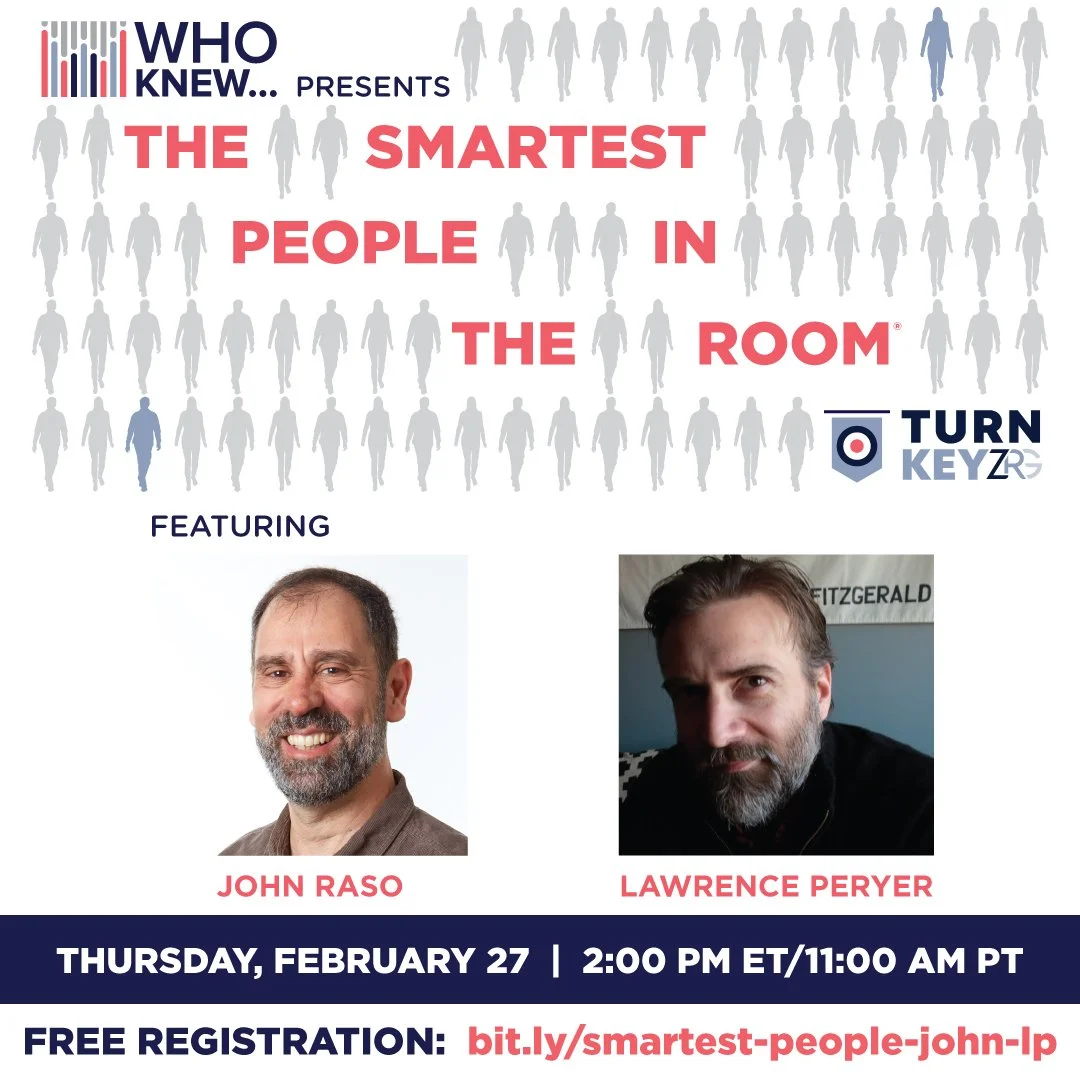
From event host Tom Truitt’s announcement:
“If you’ve been watching closely, you have to be impressed with the parade of incredible speakers we have already presented in 2025. This one pushes the bar even higher and I promise you will agree after watching these two rockstars in action.
John Raso is the CEO of Audiam, the music publishing digital rights reproduction collection agency which was acquired by SESAC in 2021. Over his 30+ year career, he’s held senior executive roles with Harry Fox Agency, Live Nation, Atlantic Records and Bearing Point. Trust me when I say he is one smart dude.
Lawrence Peryer is quite comfortable being the smartest person in any room he enters. His resume reads like no other- from senior roles with major labels and conglomerates such as Amazon, to helping launching successful start-ups, he is truly a “swiss army knife” of skills and experience. He is also one of the most entertaining and well-informed interviewers you will ever see.”
The Smartest People In The Room – John Raso and Lawrence Peryer
Tom Truitt: Welcome to “The Smartest People in the Room.” We are glad you are here. Today, I am pleased to present two amazingly accomplished executives who between them have held senior executive roles with most of the largest, most important companies throughout the entire industry—labels, touring, ticketing, rights management, you name it. These guys have done it, and they’ve got the concert t-shirts to prove it.
In short, they are among the smartest and most broadly experienced people I know, and I promise you will leave here today smarter and more enlightened than you arrived. Before we get started, please let me take care of some business.
First, to the audience: Please feel free to introduce yourselves in the chat window. The reason we do these webinars is twofold. First, we want to showcase really smart people and the amazing work they do day to day in the music industry. Many of you know that I am a music industry headhunter. I run the music practice at Turnkey ZRG, and I place music executives in roles throughout the industry. So by definition and function, I help people connect with companies. In this series, my goal is to help you make more connections, and I invite you to take full advantage of that opportunity.
Specifically, I invite you to engage with the speakers and the other attendees in the chat of the Zoom. Please introduce yourselves. Share your LinkedIn profile. Say hello to your friends and make some new ones. And ask questions of our speakers. We will try to address as many of those questions as possible during the interview.
Also, this is very important: Please make sure your chat is set to address everyone, not just the host and speakers. I want to thank our program sponsors, for without their support, we could not keep this thing free. Special thanks to MedJet, Turnkey ZRG, the Tennessee Entertainment Commission, Tennessee Brew Works, and Better Than Booze.
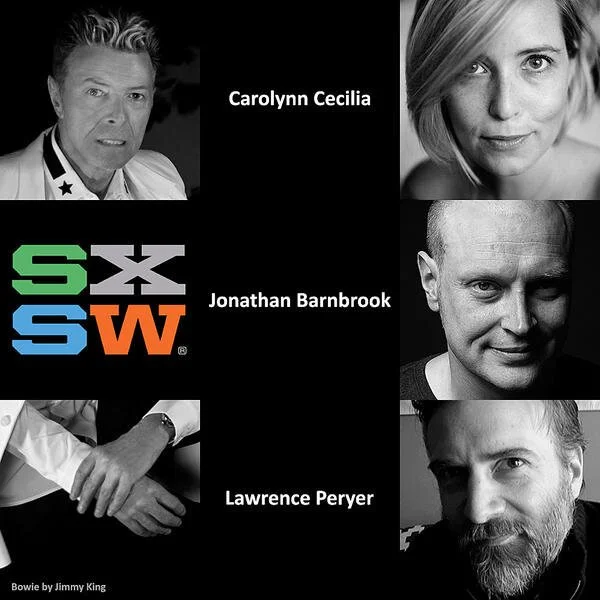
So let’s get down to business. In today’s host seat, we welcome back my old friend and alumnus of our platform, Lawrence Peryer. LP, as he’s known, is a lifelong music fan turned industry innovator. He has spent his entire career helping artists and organizations forge meaningful connections with their audiences. From pioneering early digital communities to producing Grammy-nominated box sets and award-winning retail experiences, his work lives at the intersection of creativity, technology, and fandom.
Equally at home in music tech startups and stalwarts like Live Nation, Warner Music, Amazon, and with and on behalf of cultural icons including David Bowie and Keith Richards to create groundbreaking projects that push boundaries while staying true to artistic vision. Along the way, he’s produced films, launched platforms, written extensively about music and culture, and helped reimagine how artists and fans connect in our ever-evolving digital world.
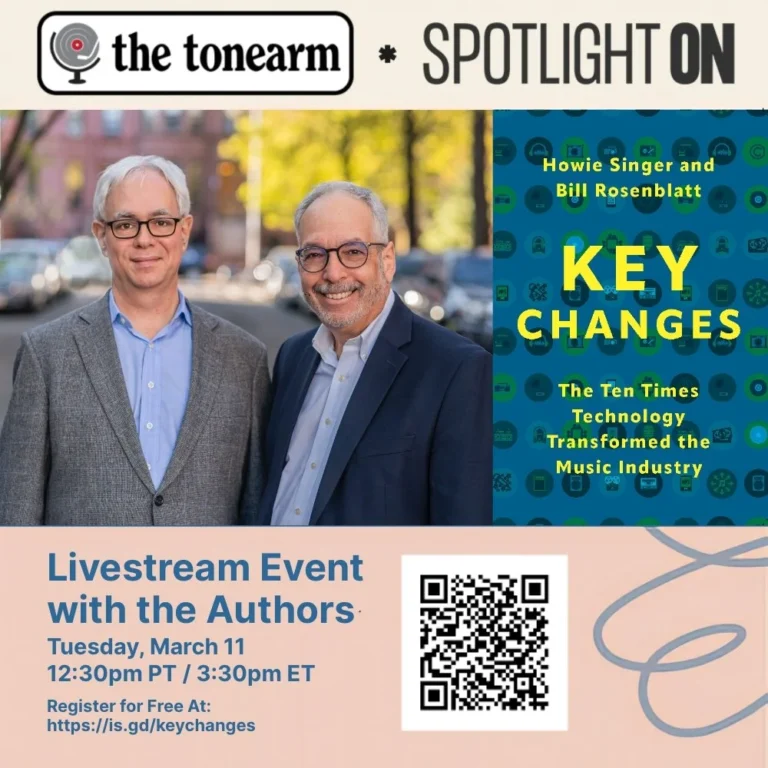
Today, as a sought-after advisor and voice of the future of entertainment and fan experiences, LP speaks at major industry conferences and contributes insights to media outlets the world over. When not working on one of his own creative projects like co-publishing the online magazine called “The Tone Arm” or hosting his weekly podcast called “Spotlight On,” he works with select clients and individuals and civic groups, bringing his passion for innovation and connection to do work that matters.
It is such a pleasure to have you back here, LP. Thanks for coming.
Lawrence Peryer: Thank you, Tom. It’s great to be here.
Tom Truitt: Amen. And joining LP is John Raso. John is CEO of Audium, the digital music royalty collection agency. For over ten years, Audium has been administering the publishing and sound recording rights for music streaming platforms for the world’s best music publishers, writers, and hitmakers. Audium uses decades of music publishing experiences and innovative technology to locate, claim, and collect their clients’ royalties globally with a focus on metadata management. Audium is part of CSAC’s Music Services Division.
Prior to Audium, John spent twelve years with the Harry Fox Agency as the head of client services, managing the team providing support to thousands of leading publishers and digital music providers. He directed the implementation of HFA’s licensing administrative services for online music and music video services, lyrics, tablature, and royalty settlements. John also spent over fifteen years in record label marketing, publicity, and product management at Atlantic, SST Records, MCA, Roadrunner, and Live Nation Artists. He also hosts a weekly radio show on Radio Free Brooklyn.
It is my pleasure to welcome these two rock stars to our platform today. Take it away, guys.
Lawrence Peryer: Tom, you’ve really built an institution here over the last several years. And as someone who belongs in an institution, I’m grateful to be here again. This is like the latest installment of our almost thirty-year ongoing dialogue. And I think we should pick up somewhere that we probably left off in one of our recent conversations, which is, I wonder if I could read to you the list of this year’s Rock and Roll Hall of Fame nominees. And you could give me a yes or no.
John Raso: Okay, pretty good this year.
Lawrence Peryer: Yeah, I agree. If you have to abstain for any personal or professional reasons, I think our audience will understand.
John Raso: Yes.
Lawrence Peryer: Black Crowes.
John Raso: Too soon.
Lawrence Peryer: I’m no. Mariah Carey.
John Raso: Just comes to the rock and roll definition. I’m gonna go no because she’s a pop star.
Lawrence Peryer: Okay. I’m gonna go yes because of her accomplishments. And I’ve given up on defining it as rock and roll. Chubby Checker.
John Raso: Yeah, definitely.
Lawrence Peryer: Overdue.
John Raso: Joe Cocker.
Lawrence Peryer: Yeah, you mentioned him about a month ago to me, and that was surprising for me, too. Billy Idol.
John Raso: Generation X should have gotten in before Billy Idol’s solo, but there’s Buzzcocks before them. There’s so many bands pre-Billy Idol that deserve to be in before. There’s no Sex Pistols.
Lawrence Peryer: Joy Division slash New Order.
John Raso: Yeah, that’s a yes. That would be in my other group of like, where’s the class of ’78?
Lawrence Peryer: It’s a hard yes.
John Raso: It’s a hard yes.
Lawrence Peryer: Cyndi Lauper.
John Raso: I was surprised she was nominated. Her accomplishments I find far more impressive than her actual…
Lawrence Peryer: I think she’s an important figure.
John Raso: We create a new category for Cyndi Lauper.
Lawrence Peryer: Yeah. I think what she did was actually important, but not Rock and Roll Hall of Fame worthy. Let’s see… Maná.
John Raso: It’s great that they’re making it more international. I can’t tell you, I’m particularly familiar with their work, but I always knew them as this legendary act, so if we’re going there, absolutely. The parameters are interesting that it used to be a Rolling Stone-centric look at things. So this is—it’s great that wall’s breaking down.
Lawrence Peryer: Yeah. I’m a yes. I know a little bit about them, not a ton, but enough to think that they’re yes. Oasis.
John Raso: No, I’m a hard no.
Lawrence Peryer: Okay, good. Let’s not even comment further. OutKast.
John Raso: Since we have—there’s a precedent for rap going in. There’s probably some other rap artists I might get ahead of them, but that just chronologically, not because of influence.
Lawrence Peryer: Yeah. Hard yes.
John Raso: Yes.
Lawrence Peryer: Phish… Be conscious that our host has his finger on the “turn you off” button.
John Raso: I have to put them in a category of, yeah. Of their—they operate outside this world, so they shouldn’t be in the hall, but I could see it. But it’s the Dead are already in like, for all the accomplishments that Phish didn’t accomplish anything that the Dead didn’t already do is the way I see it.
Lawrence Peryer: They haven’t died. I will say this: all four original members for that long period of time. That’s an accomplishment.
John Raso: Okay, I’ll give you that.
Lawrence Peryer: I know, moving on. Soundgarden.
John Raso: I want Mudhoney in first. But Soundgarden made some great records, important band, definitely at some point.
Lawrence Peryer: But they would definitely get the Innovators Award. All right. The last one is White Stripes.
John Raso: Yes. I think you’re going to know about it, but Jack White certainly gets in there. It’s hard for me when the bar has been so blurred with what’s gone in already. I think Jack White’s an incredible innovator. I think it’s the last—at this moment, that wave that they drove—last gasp of rock and roll.
Lawrence Peryer: Somebody in the chat said Little Feat in all caps, and I have to agree with Little Feat.
John Raso: I think so too. There’s a—I saw someone do Tommy James and the Shondells and on Paul Revere and the Raiders right on. Glenn, you’re dead on it.
Lawrence Peryer: Jethro Tull should be in, too, but Bad Company to me is the runaway favorite for me this year. I have a sweet tooth for classic rock and big dumb rock. I don’t think Bad Company’s big dumb rock, but they’re the quintessential seventies band in my mind and they should be in the Rock and Roll Hall of Fame.
John Raso: They are, right? Foreigner got in already, right? Like to me, there’s Foreigner’s just—because Bad Company stopped making records.
Lawrence Peryer: I think the topic of Soundgarden kind of dovetails nicely into the story of John Raso. I’m really curious. I think I told you the other day when we were talking, I’ve known you so long that there’s more about you that I’ve forgotten than I remember. And I’m super curious about some of your early work in the music industry because you were there when—in the air quotes—indie rock and college radio, that sort of golden era of music was starting to bubble up. Soundgarden on the cover of Rolling Stone, R.E.M.—those are just the big headlines. But all these artists that are so seminal and influential now, you were there when they were doing the work. And I’m curious if you could talk a little bit about what was in the air for you. You’re a young person, you’re starting your career, you’re just out of college—that’s the milieu you come into. Talk about that. What was your perception of what was happening? Did you know it was an explosion?
John Raso: No, actually—I was hanging around for a little while before. I wanted a job in the music business. I was fortunate. My older sister was a music writer, as she literally was the editor of Tiger Beat Rock magazine. This is like late seventies, early eighties. So I had the added advantage of being on the record label mailing lists showing up at my house. So I got everything like from Sire Records, so all of this stuff that sort of failed initial punk rock marketing of the major labels that—you know, all those bands are legendary now, but they certainly didn’t really break through with maybe the exception of Blondie later. We got Talking Heads and stuff like that. But as those first few records came out, nothing happened.
I was just completely obsessed, as I am now. As I think we were talking the other day, I mentioned, it’s—I almost view every single thing with the lens of music. Like, how does this relate to music? I’m reading about this because someone mentioned this in a lyric, or this guy grew up here, or this woman was writing about this place.
So ultimately I was seeking a job in music, and I ended up in Los Angeles and answered an ad on the back of Music Connection Magazine for a salesperson at SST Records. And I had already—I had owned some Black Flag records and I owned Hüsker Dü and Minutemen records. And it was like unbelievable. I was down there, and it was—ended up literally in a garage in Carson, California at a desk with a bunch of other smelly old punks. I guess we’re young punks at the time. And it was really grassroots. And so that’s making money selling—these records would sell tens of thousands of copies and it would make enough money to keep the lights on and put out new records. Like that was the only goal.
And then I had just gotten there right after Hüsker Dü had signed to Warner Brothers. And I really think that’s a seminal moment of this—the beginning of what—the year punk rock broke, ’91, as Sonic Youth and the Reading Festival with Nirvana kind of points to. The movie, the documentary too.
So as those things came along, I ended up moving back to the East Coast because I am a New Yorker and ended up working at Roadrunner Records. They had started a punk rock and sort of indie rock label called Taang! They had a punk rock label called Hawker Records while primarily a metal record. So I was there for a little bit while everyone sort of—this signing frenzy was beginning, like a lot of people were signing bands. And actually that’s where Robert Singerman, the Fleshtones manager was, who’s on our feed today managing the Fleshtones. The Fleshtones were signed to the label, as was Gangrene. And I’m trying to think of who else was there, but so I rode that out and it just didn’t really work out. And eventually I found myself looking for work, and the job I got was at MCA Records as an assistant in publicity.
MCA, as it was notoriously known as—Bob’s correcting me. I said Green Day; it was Gangrene. You’re absolutely correct. Sorry about that. They—their history rewarded Green Day much more. Apologies for that. And so I ended up in publicity at MCA Records, and it really was known as the Music Cemetery of America. They had Elton John, not at his finest around—this is ’90, ’91. And then they also had Tom Petty, who had just put out his solo record “Full Moon Fever,” but he had just signed a new deal at Warner Brothers. So he was actually out the door too.
And interestingly enough, what was going on down the hall was Uptown Records. So R&B was really blowing up big, so it was like Bobby Brown and Mary J. Blige was coming to see. So that was actually the exciting thing that I was seeing going on there, not the—not what broke through as grunge. They also had done a deal with Gary Gersh. So the new record that I’m getting to work are like Live, Fatima Mansions, Transvision Vamp—like these kind of more slick breakthrough indie-ish bands.
But they were also distributing Geffen at what’s called UNI then, and we get an advance of this record by Nirvana. And I know—part of my move out west from west, I drove along and saw Mudhoney on their first U.S. tour like four or five times, so I saw them in Denver, I saw them in Minneapolis. I was working my way out.
And then their Nirvana “Smells Like Teen Spirit” EP is in my collection of things to mail out to like local retailers and the tour. And I put it on, and it was—as I think everyone will attest to that—that’s a one spin. Oh my gosh. This is—it was so above and beyond anything, but it was right. I was like, it was so—you just—and I watched that grow. Like it went from literally, “Oh my God, we might get a gold record for a really cool band” to, “Is it going to stop at two million? Three million? Four million?” It was like, unbelievable. Like when is it going to end?
And so that’s where I—and that’s when there was a feeding frenzy. Steve Albini has a great piece that circulates about how all of that cool indie thing—everything, whether it’s humans and A&R people and bands, all got swept up into that money. And that’s—that was that big—we all got sucked up and spit out when it was over.
Lawrence Peryer: That answers your question.
John Raso: Yeah.
Lawrence Peryer: You alluded to something though, at the beginning of that, which I wanted to double-click on for a second, which is: in retrospect, is there a band or two that you can think of that are only big in retrospect? Like that we think that they were massive, but it was only in hindsight and because of their staying power or the long-term impact of the music?
John Raso: I don’t know if anybody thinks they thought they were big, even—you go to the Stooges or the New York Dolls or—I’m trying to think—the Ramones were, as they made more money on t-shirts still today, I think. I think what you’re getting there too is the difference in consumption, really probably YouTube the biggest driver, but certainly the fact that you have all recorded music pretty much at your fingertips with all the streaming services. History is all at once now.
So yeah, it’s actually—and I’ll also throw in, which I think has always been the case—I find that the tastemakers of the time that didn’t necessarily work successfully—deep music fans like myself end up so passionate about what they do, they end up in places where they get to be the future gatekeepers. So I think now—it used to be everyone wanted to be an A&R, and now everyone wants to be a music supervisor. So I think over the last twenty years, the reason cool music has been elevated is all the great music that got put into TV commercials. I remember the Stooges are in like a Toyota commercial. Can you—I can’t—and the Ramones in a beer commercial. Like it’s a little—obviously my old school take on that is “Oh man, sellout.” But at the same time, I’m so happy to see these people paying rent and having health insurance.
Lawrence Peryer: I’m not sure we’d be talking about Nick Drake if it weren’t for that car commercial.
John Raso: Absolutely. And I—obviously a big music fan—the first I really heard Nick Drake was a Volkswagen commercial. That’s crazy. I heard the name, but remember records used to be hard to find.
Lawrence Peryer: That’s right. Yeah. And the other piece—everything, the entire history of recorded music is available, yet there’s very little context, which is fascinating to me. I’ve talked about that probably with you, but certainly with other people, which is having the benefit of working with younger people over the last ten, fifteen, twenty years, in the digital era. There’s very little differentiation between like high and low or pop and underground. Like people just like music, and they like songs, and a lot of the things that we loved and that a certain brand of music fan likes in terms of digging deep and going into the backstory and finding the family trees and all that—not every music fan has to have that as their experience. I don’t necessarily like to bemoan the loss of it because it’s just—I don’t want to be the old man “get off my lawn.” There’s one way to like music, but it’s super fascinating how when all music’s available all the time and you take away the context of scene and genre and era, what rises and what people find. It’s super fascinating.
John Raso: Do you find yourself—I admit guilty on this—is there’s things that you didn’t like at the time because of their context? Particularly, we go back to the sort of the launch of what was called grunge and all that breaking through. There was bands that—it’s like, “Oh, it’s another one of a band that sounds like this.” But in retrospect, like I think I’ve said, at the time, Stone Temple Pilots just felt like, “Oh, this is the pop version of the music I like.” But originally, they’re great songwriters, writing great Zeppelin-like riffs. And it’s—you take it out of that sort of competition piece of it, and you’re like, “Undeniable great songs that sound great.”
Lawrence Peryer: I think that’s right. I think for me, I think the era that’s like that is probably the late seventies, early eighties new wave, post-punk stuff. A lot of the early MTV hit stuff that I thought was bubblegum. And you go back and it’s “wow, these songs and the productions really stand up. This is meaningful music.” Yeah, so I definitely get that.
I’m curious as your career evolved and you moved into the major labels and you spent time at Atlantic—I’m struggling to articulate this question, but I’m curious about the differences in how major labels operated versus where you came from, right? Like versus something like SST. And I don’t just mean like people sitting in a garage versus people sitting in an office in Midtown. More like attitudes towards artists, attitudes towards fans. Was there a big difference? Or because my—a lot of my perception has been I see idealism, but I don’t see changes in behavior, or I don’t see the idealism reflected necessarily outside of certain pockets of individual artists.
John Raso: My direct experience was—the thing that shocked me most is when I went from an indie to a major is that I actually no longer dealt with the fans. Like the majors deal with record stores, right? This is definitely old record business, because I frankly I don’t know if I have any skill that would be relevant to a record label as a record label’s defined today, because marketing in a digital world is completely different than what it was then, because you’re—now you’re actually marketing to the people that listen to the music.
In retrospect, at where I was at the majors, it was convincing certain writers, certain video programmers, certain radio programmers, and increasing your orders from the retailers. Those were your essential audience—was that. So it was hundreds of people, and that—so that was a huge difference. I felt like everyone didn’t go to shows once I was—I was a music fan at a major record label, and that wasn’t always true of everybody I worked with. Whereas certainly, the minuscule salary—and I was there for the passion at the indie label, which might’ve been the way it survived is nobody got paid anything, but I went to shows every night. So my fellow workers at all the shows, we supported our bands, bands from other labels slept on our floors. It truly was a network of supporting that industry. I remember being an SST when the Pixies came through town—the Screaming Trees slept on my floor. It was very—it was great. It was really great. And really personal.
I saw a show with Soundgarden in Long Beach, California, and there was eight people there, and I worked with half of them, but Chris Cornell still had a shirt off by the second song and is wailing away. It was pretty awesome. And the majors, it felt like there was a release schedule. And we have to get the parts out and this together, and it has to be out by mid-November so that it’s in stores for Christmas. You got to get so-and-so to put out the—we need a record. I don’t care if they only have eight songs; we need to get another two songs to turn this one out.
I was at the time where even the majors were moving from privately held to corporate, where it became farther and farther away. I was a product manager, and I got dragged into that whole thing where closed doors and—is the head of HBO had taken over Warner, and was Doug Morris going to be out or in? And he ended up starting Universal, essentially Universal Music. I forget what the name of the company is, but taking over PolyGram—it became—and bought MCA and all of that happened. And it was these big corporations and part of the consolidation of the majors. And that’s where all the catalogs are now, which is that’s what keeps them alive. It certainly hasn’t been their progression as far as scooping up music. I feel like no one’s going to talk to me now, but…
Lawrence Peryer: Yeah, that’s okay. It’s interesting because your time that was spent more on the recorded music side was really—
John Raso: Far-flung out.
Lawrence Peryer: That’s a blast from the past. You were there through a lot of musical and cultural shifts as well as business shifts. I think it’s a really interesting vantage point that you have on the recorded music side of the business. But then if I have to think about John Raso as a career for the last fifteen, twenty years, it’s almost exclusively thinking about publishing. Not entirely—you really got to another part of the business in a very deep way.
I’m curious if you could—I’ve been doing this a long time as well. At some point, everybody scratches their head because they run into something publishing or rights-related where they just say, “I really don’t understand how that works.”
John Raso: It keeps me employed for sure. It is—publishing is really difficult, really—it’s purposefully complicated from decades ago. And untangled now.
Lawrence Peryer: Did we lose you?
John Raso: That’s simplification of how rights work.
Lawrence Peryer: I don’t know—I apologize.
John Raso: I just got an unstable internet connection, so thank you, Spectrum. Sorry about that.
The concept of publishing being complicated—that over the last ten years, it’s actually really streamlined the business in a lot of companies, including what I’m doing over at CSAC and the Music Services Group, is bringing all the different—now that we deal with creators directly, they don’t realize they’re actually five different companies. It’s like, “I made a record.” That makes you a record company, an artist, a songwriter, a music publisher, and probably a marketing entity, self-managed. And so you—it used to be, you had a different person that did all those things.
I just was having a conversation with someone yesterday who had opted into a licensing deal with Meta for their sound recordings and wanted to know why the music wasn’t—it’s “Did you license the publishing to them?” And it’s “No, I didn’t think I did. I licensed the sound recordings, of course.” And I had to explain, “No, you have to go here and opt into this license agreement to grant the publishing rights as well, because you wrote the songs.” And so that’s where—I don’t want to jump too far ahead of where we want to go in the conversation. But that’s what’s going now is you could walk into one door and you have people like me and all the people I work with who have had these varied backgrounds from the labels to the publishing side and go, “Okay, we could do all these things if you allow us to provide these services.”
And it’s pure back office. We stay completely out of the creative side, and it allows a creator to literally do all of these things and not have to go, “Okay, I need to talk to these eight different people and make sure my data is here and that I’ve signed an agreement here and my royalties are getting paid here and I bank account set up all over the place for where this money should be paid.”
But I ended up with the left hand turn in publishing because I started to see this when we initially worked together—it was the record companies were—there were, it was going to be the end of record companies. The internet was going to put an end to all the record companies, and no one was going to—yes—and everyone’s going to have music for free by picking up the phone and dialing a nine hundred number. But ultimately that—the people who weren’t passionate about what they did and weren’t for the internet piece of it and the marketing of that, the growing market and the creative side came together. And it eventually, as it struggled over the next five or ten years, evolved into the iPod and the evolution of digital delivery. And finally to streaming that evolved to—think about how quickly that moves.
The piece that I ended up at—having dropped out for a while doing pure consulting, I’d worked at consulting at Bearing Point KPMG. And my first gig was with the Harry Fox Agency. And then I did ASCAP, and then eventually I took a job at the Harry Fox Agency. Now almost sixteen years ago, and I just happened to be literally at the right place at the right time. Napster was trying to get licenses for—they—all these streaming services went out and got deals to license the sound recordings. And then it’s “You can’t launch; you need to get publishing licenses.” And all the companies were like, “What?”
And through some smart thinking with people that are still at the Harry Fox Agency was like, “Wow, we have a database. We have a history of licenses between sound recordings in music publishing. We have a valuable asset that could bring these—this is the new record company.” Essentially you’re now requiring the record store to get a license for everything that they sell, which was description-based. And through that history of data, we’ve figured it out. There was—I don’t want to go too deep into the, because it does get—gets really legal-centric. There’s compulsory licenses, statutory rates, what you can do. It wasn’t designed for the kind of volume that you’re putting up. But all of those problems got solved. And we had relationships with the biggest streaming services.
And as a result, like doing it literally every minute for day after day, we figured out how it worked. And that exact model is the model that ended up being what became law and established in the Music Modernization Act that is now the Mechanical Licensing Collective when what they came and engaged the Harry Fox Agency. So our contribution there has been—it’s been great. It’s I think it’s been working out pretty well as far as it’s made it simple for people to know where their publishing royalties are for all the major distribution points.
Lawrence Peryer: It’s interesting because you had said that it transitioned to streaming fast, and I think people who maybe were on the label side or even artists, it probably didn’t feel fast, right? Like that period from say 2000 to maybe 2015 or so when streaming really started to hit scale. Yeah, those were—it was a dark time. We have literally thousands of colleagues who I don’t even know where they work now, like they left music. And whether it was salespeople, distribution, supply chain—like just a gutting of the business. But you’re right, big picture-wise, it was a very rapid transition.
John Raso: Remember, but you remember the celestial jukebox? Like it seems so farfetched and—but at the same time, it’s like—there’s that thing being passed around for years now of Zappa talking about it, like in the late eighties. So it was—it was just—it was a matter of bandwidth. And then there was the fight from the labels of “We’re losing control.” But as you see now, they’re making more money than ever. They’re back to multibillion-dollar businesses. It’s just that pain—but yes, there’s definitely casualty of some great people that—but it’s wonderful to see record stores all over the place again. Like it went through a big house cleaning, and it’s resettled. And I think we’re getting to a pretty good place. I didn’t want to come off as saying, “Oh, it’s so wonderful.” And it’s great when there’s a lot less people making the money they used to make, but there’s also a lot more people who are in that never would have been in before, like they got through the door. Their music is available. Yeah. So it’s an interesting trade-off.
Being the kid in high school or college, trying to figure out how to get a pressing plant, how much money do we have to make the record, where are we going to get—what’s mastering, and going through that whole thing. And then it’s “Okay, now we’ve got a record; now we can sell it and ship.” It was arguably that struggle also made the music better too, though. Yeah, absolutely. But the filtration process is a little less. You get it a little more raw now, and you have a little less time to make mistakes, and it’s so much more in public.
Lawrence Peryer: Yeah. I’m curious, given that so much of the last decade and a half for you has been—if not a little more—has been focused on in the publishing world. And so much of your work was supporting and working with publishers directly when you were running client services and even in your current role. Given all the change that’s happened and all the new opportunities that have been presented because companies like yours have figured out the plumbing and the flow, what are the pain points that you hear from publishers right now? And again, I’m happy to put aside the rates point as well, because I don’t think anybody in the music business is ever happy with what they’re making. But what are the things that come to you and say, “Man, this problem just won’t get better”? And what are the intractable problems that are still left?
John Raso: As Tom mentioned in the interview, I’m in the music business, but I have to say most of my bandwidth and my team’s bandwidth is cleaning up data. Like it’s always been a problem. And I just think we’re paying for that history of bad data forever, and it’s slowly getting better. And it’s so much better than it was ten years ago. So as a result, people are—I see Robert Singerman calling it as over-claims, but all of this drives from bad data, right? You have bad actors—you’ll always have bad actors, right? And they purposely make over-claims. They’re claiming fifty percent when they should only be claiming nothing. But some of that I find is ignorance too. It’s “I made a recording of this song, so I should register it with the NLC or Harry Fox or whatever.” It’s “No, just because you record it doesn’t mean you control the publishing.” And they’re like, “Oh, I’m just getting my streaming royalties.” It’s “Yes, you’re allowed to the recording streaming royalties. You get those through your distributor, not through the publishing entity.”
So there’s a lot—I still think there’s a—because you were only a computer and a credit card away from being public, you—there’s no training and pre-education before that to know whether you’re doing it wrong or right. And I think that’s where the consulting—that’s where companies like Audium and even the distributors like TuneCore has a publishing arm. Downtown Music, Song Trust—they’re conglomerate there. They have—they and so as a result that they’re—they create an aggregate in some filtration of getting that a little better. It gets—sometimes the volume so big that gets through as well.
But so that I think is the challenge is you can’t set it and forget it. Those days are gone. And in fact, there was a sort of—I don’t call it a learning curve, but a change in attitude from publishing used to be people came to me and got permission, and if they didn’t and had success, I would find out and come after them. Right now, it’s a much more proactive business than it used to be. And the old saying was like, “Oh, mailbox money.” And to a certain extent there, that was great. My grandfather wrote a hit in the forties, and my kids are going to college for free.
Lawrence Peryer: Exactly. But you’re—it’s funny, things like this happen all the time. It almost drives me nuts when there’s like a—I see a new hit song that has a famous song title, and I just know, “Oh, that’s going to be trouble.” Like I’ve been recently—we represent one of the older catalogs and have this—the old standard that “All of Me,” Django Reinhardt’s recorded, Billy Holiday’s recorded, but there’s a huge John Legend hit called “All of Me.” And I’ve been cleaning that one up. It’s pretty amazing how machines aren’t—machines are only as smart as you make them. And there only has been more so—only as good as the data you put into them.
John Raso: Yeah, it’s really fascinating. I wanted to find a way to talk about the ways technology can help in your business. And there’s like obvious ways of databases and automation and things like that. But we have this world now where not a day goes by that we’re not seeing some press release or news article or something really fascinating and terrifying around AI and all the things that it can do. “All of Me” showing up in your error report, or whatever it is, however many times a month you have to deal with it, and it’s—it also reminds me of, I don’t know if you remember this, but when you were first working at Bearing Point, I think I came by the office or something, and we met for lunch, and you were on site at that point, at Harry Fox, I think, and you showed me the index cards. And they were literally three by five index cards that were typed on, and it had the name of the song, the name of the artist, I think the publisher, and which performing rights organization, and there might have been some other data. And you were like, “Here’s the database.”
Lawrence Peryer: Yeah, pretty much. That was the project I was working on at ASCAP.
John Raso: Yeah, that was like—I want to say there—just a brief history, there was a thing called the IMG, but it was supposed—this big European joint venture to put all the databases together, which has been attempted multiple times. And at some point, it’s always cost money or theory that sort of breaks it all down for the cooperation, but that was—it was like “It’s not being built for everybody, but we’re going to need this. So let’s do it.” And so I ended up being part of the requirements gathering process for membership in the database. I think it’s the same—still the same system there pretty much using now. And it was mind-blowing, but the same thing at Harry Fox. One of the things I have—the typed index card for “Oliver’s Army” by Elvis Costello. Like I was like, “Okay, if this is getting thrown out, I’m keeping it.”
Lawrence Peryer: I have “Nothing to Lose” by Kiss.
John Raso: There you go. See, there’s great stuff, but it’s all at a scrapheap somewhere. At this point it’s probably—hopefully it’s turning into trees somewhere, but yeah, we’ve—we certainly have tried to figure out, or I should say, are trying to figure to utilize AI to figure out the classic. “Okay. Here’s a song called ‘Stairway to Heaven,’ and it’s performed by Bob, Joe, blah, blah, blah. Can you find somewhere out in the interwebs where you’ve gathered that it’s a cover of the Neil Sadaka song or the Led Zeppelin song?” Because we know if you say Led Zeppelin, we know which one it is. If you say Edie and Stephen Eady, we know it’s probably the Neil Sadaka—it’s like you were based on the year that it was.
So there’s—we’re still—we’ve run a few examples, but it’s not good enough yet. It’s—we’ve—we—if anything, it’s—we’re trying to find the level of trust where it kicks out into manual review because at the end of the day, it’s all the time I get put examples. “How did you get this wrong?” When in reality, it wasn’t a person that got it wrong. It just didn’t kick out properly for exception handling or that it did. And it’s still sitting there, and it hasn’t been corrected yet because it’s in the “Oh, it’s going to impact less than a cent” world. There’s—you—just like anything else, you have to drive it—what’s going to be the biggest impact.
And as a result, even the experiments we’re doing, we have to be so cautious because the database that we all use is utilized by so many places. Like when people come to the CSAC Music Group Services, which includes Harry Fox and our Rumblefish service, which essentially drives a lot of blanket licensing direct agreements, that is the starting point for all of the services that you essentially get paid out of. So make sure your songs are straight in the MLC database, which is the compositional database that HFA manages, and almost every service—the possible exception of Google in the United States—works off of. Get it straight, deliver the sound recordings, deliver artist name as well as ISRC. So ISRCs are turning out to be a bit of a mess, where we’ve seen scenarios where “I put out a record and I signed the first ISRC and I drag it down on my Excel spreadsheet. Oh, it didn’t make it one more”—all ten tracks have the same ISRC code.
Lawrence Peryer: Just tell people what ISRCs are.
John Raso: Oh yeah. Sorry. It’s—I believe it’s the International Sound Recording Code, and it is the unique identifier for a sound recording. Similarly, there’s something that’s called an ISWC, which is the unique identifier for a composition. Those are utilized greatly in Europe. Been very much so more in use in the United States, but there’s still a backfill issue going on there. It’s a slower process than the streaming services really need. So those are the key things, but I’ll tell you, matches aren’t really strong unless you get an artist title match. Like almost everything gets kicked to exception and doesn’t get automatically matched if the title doesn’t match. And we—our algorithm does exclude things like, “Let’s Get It On” featuring—like if it’s parenthetical, it gets ignored because we know those aren’t that. But the artist’s name, we have—we have variations on all these, but if it doesn’t get an exact title match, it gets kicked and go—and as a result slows the process down.
So put in every alternative title you could think of. Do not register another song for “Part One” and “Part Two.” It’s the same composition; just add that sound recording information to the composition, as connected information. And there’s means of bulk spreadsheets that are delivering all this information either to HFA or to the MLC.
Lawrence Peryer: It sounds like a fucking nightmare.
John Raso: It is.
Lawrence Peryer: It’s shocking anybody gets paid.
John Raso: But it is. But that’s the thing—what’s great is eighty-five, ninety percent of people do. It’s good. You’ve seen—I’ve occasionally said to you, I’ve written to you, “Oh my God, I just got—straightened out, like the guys from Crazy Horse, they’re all going to get paid now.” And I think you wrote back to me, “You’re doing God’s work.”
Lawrence Peryer: Look in the chat—look at Todd Tate’s comment right there. “A good match is dreamy.” And when I read that comment, I felt it viscerally. I was like, “Yeah.” And you get that—you get the—when the data all lines up and you’re like, “Oh, this—my day is not going to be derailed by this stupid ampersand in Neil Young and Crazy Horse.” I’m so happy.
John Raso: That’s it. And I try to use that as a way to have my team feel connected to what they’re doing and that it’s not just—it isn’t—I do joke. It’s, “If we did this exact same job in finance, we’d be loaded.” Instead we’re doing it because—so let’s connect—like we do—it’s “Hey, let’s clean up this. Can we really—oh, we love this artist. Let’s everyone fight. What’s your favorite version of the song? Let’s make sure we have it. Let’s—let’s dig up—we do a Christmas dig every year. Let’s find all the Christmas songs that we have. Let’s make sure it’s all set up.” So it’s—yeah.
It’s interesting because the human side of that is the stories you hear about artists that can’t pay their medical bills or the ones who have cancer and are like living in—like what’s going on with David Johansen.
Lawrence Peryer: David Johansen.
John Raso: Yeah.
Lawrence Peryer: These are not obscure minor figures—maybe to some they are, but these are our pioneers and our heroes. I guess your point is that like you’re actually cleaning up data that’s going to make money flow. That’s going to make some material impact in somebody’s life somewhere.
John Raso: I hope so. That’s why I want to—I didn’t want to just dismiss that royalty rates are—like you don’t live off of the same things you used to. Like the “I had the B-side of a hit, and that put my kid through college”—that, like that—there’s no B-sides anymore. There’s—I’m not track eleven on a big album. That sort of stuff doesn’t happen. So it’s spreading the money very thin now.
Lawrence Peryer: We’re starting to hit towards the end of our time. I wanted to ask some questions about some of the other—you said early on, and I think you said it to me last week—you view everything through the lens of music, and I’ve been thinking about that a lot since you said it, and noticing it in my life, like how everything basically relates back to music in some way, and your examples about “I’m reading this book because I saw an artist mentioned it or was in a song lyric and I had to go Google it.” And all of a sudden, I’m on a Wikipedia page about the wreck of the Edmund Fitzgerald or something, but—
John Raso: That won’t happen.
Lawrence Peryer: And so I totally relate to that, but I’m curious—you’ve played around in like music-adjacent things. You had the radio show. Do you still do the radio show?
John Raso: Yeah. Yeah, I do it every Monday on Radio Free Brooklyn. It’s at five o’clock Eastern time. And I do—it’s like a theme show. So it’s one hour, and I put together a theme. I did it—I cheated a little this week. I thought it was a great idea. And then it turns out it was so abundant it made it too easy, but it was only song titles that are a question. Just to give you an idea of what I opened with: “Are You Ready” by Grand Funk Railroad? Because I am a secret fan. Are they in the Rock and Roll Hall of Fame? They should be in the Rock and Roll Hall of Fame. At least for the first—the red album, the second album. And then I also did—Roberta Flack had just died. So what was their—the Holloway—I’m going to blank on the song. Someone in the chat, we’ll give it—okay.
Lawrence Peryer: “Killing Me Softly” out of my head when I think of Roberta Flack.
John Raso: Yeah, how long have you been doing it? That particular show seven years I’ve been doing it every week for seven years. Prior to that I did three years on a—it was just I only played bands that were in town that week. So thank God I was in New York City, so this June fifth, ten years on the year at Radio Free Brooklyn, I’m one week shy of the entire history of the radio station. So very proud of that. It’s a lot of fun. It’s also buys me some credibility to get to be the DJ at any party I go to.
Lawrence Peryer: That’s amazing. And you’re not doing the Beatles podcast anymore.
John Raso: The Beatles podcast was a fun experiment. It was called “The Beat Down.” And it was just a friend of mine that said, “Hey, you and my friend, Chris, you guys are always telling like the deepest, weirdest Beatles stories and we’d ever—or whatever music story, but always relate back to—and the connections of the Beatles is X”—like “How’d you turn a Ramones story into a Beatles story?” They’re named after Paul McCartney’s name. He used to check in at hotels as Paul Ramone. And so he’s “Can you guys just do this on a podcast for me?” And so it turned very similar to like almost like the way you listen to sports radio, except we were talking about music. So we did that. It was a lot of fun. So yeah, I’ve done that for about a year.
Lawrence Peryer: What are you—what’s on repeat for you right now? What are you obsessing over?
John Raso: I’ve really gone deep into vinyl record collecting now, as I mentioned, I’m throwing my first record fair up in the Catskills Memorial Day weekend in a town called Lexington, not far from Hunter Mountain Ski Resort. And so I’ve been buying up lots of people’s collections and stuff like that. I always find myself—I keep going back to my Black Sabbath records. Like they always make me happy. The first two in particular—I love them all, but they’re just—they erase a bad day in a matter of minutes. So—
Lawrence Peryer: I’ll tell you that the first Black Sabbath album—I wish I was of a certain age when that record came out and I could have stumbled across it in real time without any context, like walking into a record store and finding that record. It had to be mind-bending.
John Raso: I live—I’m a little older. So I lived in a world where “Iron Man” was staple—you heard it all the time. And I just remember as I must have been like eleven or twelve. And I had a friend—we’re listening to the first Black Sabbath record—the babysitter comes downstairs and goes, “Black Sabbath, oh,” and left the room.
Lawrence Peryer: It led to a life of—yeah, I don’t know, an ill-spent life in music. What are you holding tickets to, anything?
John Raso: I’ve actually—I’ve been struggling with post-COVID. I haven’t been able to get my concert-going mojo back. I used to go three or four times a month; now it’s—I will see fifty different or a hundred different bands at South by. I’ll try to sneak in some times that we have New Colossus now coming on, which is the bands on their way to South by in New York the week before. So that’s my big thing. I guess most recently I went to go see this great British band called the Bug Club. And that was even—that was a couple of months ago. They’re great. They’re a little bit of Jonathan Richman, but they’re a trio, and they’re amazingly talented. They go off on these jams that are surprising, and their lyrics are like really clever and straightforward too. I can’t recommend them enough. They’re pretty great. They’re from Wales, I think.
Lawrence Peryer: I think we have to meet up later this year for Elvis Costello because he’s doing the greatest hits tour.
John Raso: Yeah. Last time I saw him was with you, and I think we saw him at Merriweather Post or something like that. And it was disappointing.
Lawrence Peryer: Wolf Trap.
John Raso: Wolf Trap. He was like angry.
Lawrence Peryer: Yeah. And it was like the “When I Was Cruel” tour.
John Raso: I saw him at the Brooklyn Bowl with the Roots, and it was good, but—
Lawrence Peryer: Oh, I did that. That was the last one. I forgot about that. That was exciting to see him. It was completely out of context, and it was like last minute. That was great. But I saw him when he got inducted into Songwriters Hall of Fame. He came on and did “Alison,” and I was a little disappointed. He didn’t go a little deeper cut.
Lawrence Peryer: That’s not the cloud.
John Raso: Cloud.
Lawrence Peryer: Tom, do we need to—did anything from our audience here?
Tom Truitt: There’s a couple of good ones. Here’s one from our pal Robert Singerman in the Q and A says, “What are some—”
John Raso: Intern for Robert Singerman.
Tom Truitt: You were?
John Raso: Yes. When he was managing some great artists. That was fun, Bob.
Tom Truitt: No wonder you’re in the “Smartest People in the Room,” because he is the smartest guy in any room he enters. He asked a question down here says, “What are some of the upcoming advances in the music business you work with that are exciting and can change the game? We all know why he wants to talk about that one. But seriously, do you all see anything out there not called AI that are exciting and can change the game?”
Lawrence Peryer: I think we all have multifaceted and complex feelings about AI, and there’s so many aspects of it to talk about or not. I have almost no opinion on AI as it relates to creators and creativity. I think people should use the tools that they’re going to use, and I don’t get a vote on that. I have a lot of opinion about AI slop, but again, that’s for another day as well. I actually—I talked to a lot of my clients about how they’re using AI administratively and to off—as a force multiplier in their businesses. And so I don’t know if that answers the question in terms of things consumers will see. But I do think I’m seeing some interesting pilots of companies and organizations using AI to be either more efficient or to unlock capabilities they didn’t have before and be able to move faster in our business and a lot of resource-constraint organizations. And as somebody who grew up as a lover of technology, not a utopian, but certainly an optimist, I’m excited to see some positive applications of this technology because it is so complex and scary. But on the consumer side, I see a lot of patterns, whether it’s in ticketing or the this sort of era of direct-to-fan. These are all things that—you know, every seven years or so another crop of company comes along and doesn’t really do much. Raises some money, throws around the word “disruption,” and goes away. I don’t have a positive answer to that question, and I feel a little delinquent in that.
John Raso: I’m gonna have to concur with that completely in that it’s—there’s a lot of technologies that—solving a problem that’s looking for a problem to solve rather than—it’s the technology first scenario seems to be—look, it’s like blockchain was going to save our industry. I don’t think the technology is the problem. It’s the knowledge. I’ve used the example before. It’s we’ve built a rocket ship, but we don’t have any astronauts. So there needs to be—as we educate more and more people about how to deliver data properly, where it should go. And we’ve been simplifying that process. My biggest technological challenge is wording application forms so people know what I mean, like without—education and publishing, it’s like, “Oh, do we call you a publisher? Is it a catalog? Is it a—are you the administrator?” Like what words do we use? So you know what information to properly put in this field so we ingest it—like that. That’s been my biggest challenge. And I think it’s the great mandate of the Mechanical Licensing Collective is that it has a lot of funds to go out and educate people. And that’s made life better. The smarter people get, the more they appreciate what I do. Being a customer for service for so long.
The thing I hate most is when someone came and they were mad at me, but I was taking their call, trying to help them. I did not create the rate. My job is to get you through the system as best as possible. I understand. I’m the ear you could yell into, but I’m part of your team. I’m not fighting against you. I also understand the frustration. I really do. Unfortunately, I don’t think there is any technology that’s really going to change the game right now. And that’s from an administrative point of view—creatively.
I find it evolves too quickly right now. And as a result, no one ever gets good at it. And it moves on to the next process. It’s like the LP was invented in the forties, and we got “Sgt. Pepper” twenty-two years after that, so how long—like a TikTok video is what, five years as the last? And it’s—we keep cramming—like now you have to be great in thirty seconds. And it has to be—I feel like the medium has been so impactful on the art. The art isn’t able to really mature. And it becomes more—the delivery becomes more important than the product. I think a lot of artists have held on to the album.
Lawrence Peryer: Yeah, no, I think that’s why so many people still make albums because it’s a stabilizer.
John Raso: It’s like in this ever-changing world, the—
Lawrence Peryer: —the CD ruined the album. Like everyone had to make an eighty-minute album. How many great double records are there? Yeah. Give me a great thirty-five minutes. You could keep your other—your deluxe B-side twenty-seven tracks. I just got to get off my lawn.
Tom Truitt: Guys sound like old boomers right now.
Lawrence Peryer: We really are, Tom. We’re the worst. There’s another—
Tom Truitt: question from an old pal. Tyler Sewell is asking, “What do you guys think about the British government making plans to change copyright laws, which would enable AI to develop and train their models using copyrighted work without a proper license?”
John Raso: I don’t know enough to really know what’s going on there specifically. I know that I’m lucky, in that I only have to be reactive of what gets decided. But I want my music to be human.
Lawrence Peryer: I don’t necessarily—I don’t mind—again, the creative tools, I don’t have a big opinion on. I do have a big opinion on—as self-serving as it sounds—someone who’s who likes to think they’ve worked on behalf of artists their entire career and artists should get—you have a right, you have a copyright, you have a creative right to your work. I just don’t think somebody else gets to come along and do whatever they want with it. Even sampling got worked out. And I get that popular music and popular culture is iterative, and it always builds on what came before it, but the ability now to do it at scale—I don’t think we can make the old arguments with this new technology. So I’m against it as well.
Tom Truitt: I think that is a great wrap-up point, gentlemen. Again, let me thank you for being the smartest people in this room today. You are always welcome to come back anytime you want, LP and John, to host one of these and continue this conversation or start others. To the audience: Thank you for your attention today. I promised you’d be leaving here smarter and more inspired than you arrived. I think we delivered on that. And with that, gentlemen, I will say, be nice to each other. Have fun. John, be safe skiing. And I can’t wait to see you all at a conference. Y’all take care. Thanks so much.
John Raso: Great seeing everybody in the chat.