Spotlight On Key Changes: The Ten Times Technology Transformed the Music Industry
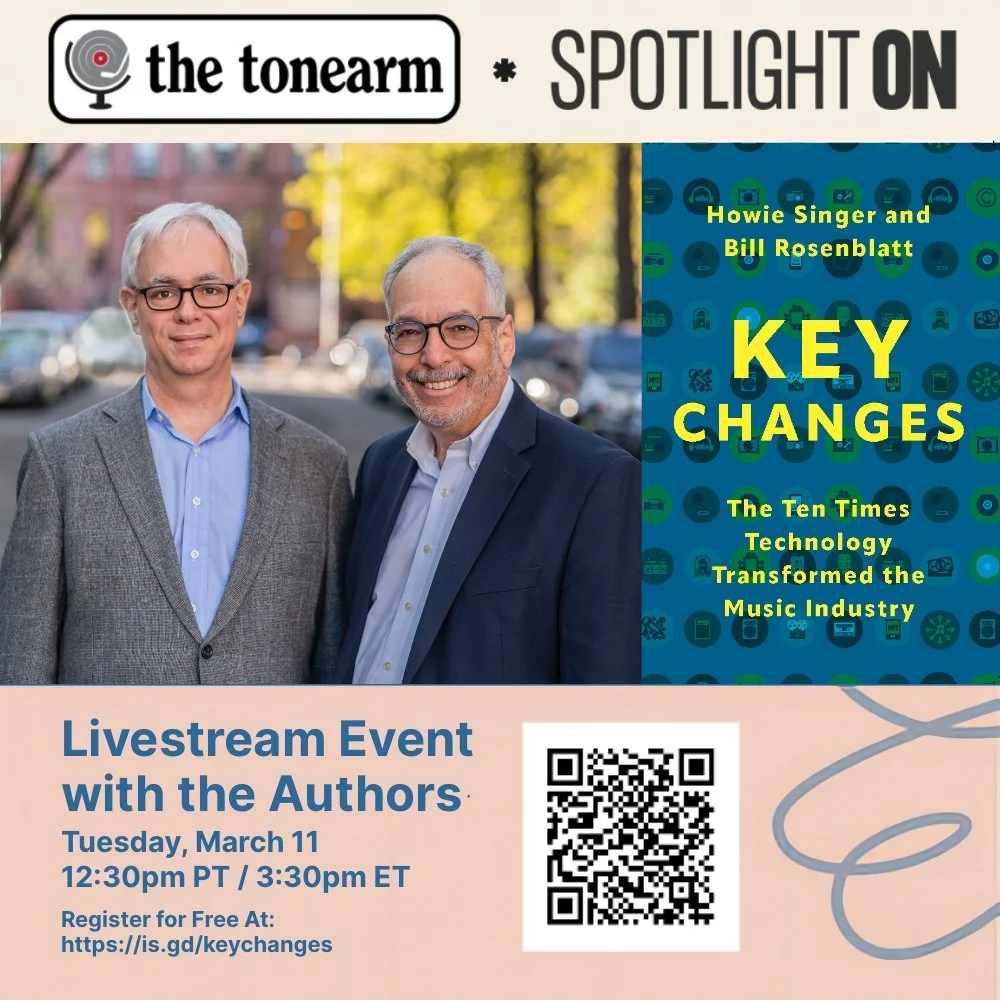
Join Spotlight On host Lawrence Peryer in conversation with Howie Singer and Bill Rosenblatt, authors of Key Changes: The Ten Times Technology Transformed the Music Industry, available now from Oxford University Press. “
Key Changes examines ten technological disruptions that reshaped the music industry across the past century, from phonograph records through streaming platforms. The authors show how the music business adapted to evolving distribution methods as they trace the recurring patterns in responses to innovation like radio, television, cassette tapes and the digital era.
The book also includes insights on emerging technologies like artificial intelligence and blockchain, proving that while technologies change, the business transformations follow predictable paths.
TRANSCRIPT:
Lawrence Peryer: Welcome. Thank you for joining us for a discussion with authors Howie Singer and Bill Rosenblatt about their book Key Changes, the 10 Times Technology Transformed the Music Industry Out Now by Oxford University Press. Key Changes tells a thorough story about the history of the music business and the 10 technological advances that disrupted it over the last century.
Plus we have a lot to talk about, but first, some quick intros. Howie Singer is an expert on music industry technologies who has played a leading role in the transition to digital music delivery. I. At Warner Music Group, he served as SVP and Chief Strategic Technologist analyzing new business models and services.
Since 2018, he’s taught a graduate level class on data analysis in the music industry at NYU, how he spent the first part of his career at Bell Labs and at and t where he co-founded A two B music, an early digital music startup, which I remember well. Bill Rosenblatt is a leading independent expert on technologies related to copyright in the digital age as president of Giant Steps Media Technologies Strategies, the firm he founded in 2000.
He’s consulted to leading media and technology companies as well as public policy entities worldwide, and he served as an expert witness in intellectual property litigations on these subjects. Bill teaches data analysis in the mu music industry, in the music business program at NYU as well as for me.
I’m Lawrence Purer, host of the Spotlight on podcast and co-publisher with Michael Donaldson of the Art and Culture website, the tone arm, Howie Bill and viewers. Welcome.
Bill Rosenblatt: Thank you. It’s great to be here.
Lawrence Peryer: It’s great to have you. I’d like to let viewers know that we’ll keep an eye on the chat and if anybody has questions and wants to drop them in, we’ll do our best to get to them.
Otherwise, everyone can sit back and enjoy what is going to be an enlightening conversation with how. And Bill, I’d love to start at the beginning. I’m gonna do my best to alternate my questions between you, but please, either one of you should feel free to step on each other’s toes and finish each other’s sentences, which I’m sure you’re capable of doing at this point.
But I’ll start with you Howie. I’d like to go to the beginning of this project. What prompted you to undertake this book? And I’m really curious about how long the journey took from the light bulb moment to when we were able to hold something in our hands.
Howie Singer: I had the idea when I was still at Warner Music, ’cause when, that’s where we met Lawrence and, we knew we were living through some stuff, we were there, the b the dawn of the iTunes store, the death of the cd, at least in terms of revenues in the big, in a big way, the birth of streaming. So I, I felt I was being the, had a front row seat to these changes that were happening to the industry. And I actually started a folder and started, keeping notes then and, kept working at Warner and then some books came out about that.
I. Napster era, appetite for self-destruction and others that covered that time period pretty well. And as I thought about it some more, and after I left Warner Music and started teaching I wanted to teach and I went to Larry Miller, who was my partner in that early digital music startup way back when, was running the N NYU U Music business program.
And I said, I have an idea for a book and a class. He said, that’s great. It’s gonna take you years to do that. Why don’t you teach this data class, which I’ve been doing ever since. And then literally just about five years ago, we all got locked down for COVID and I started writing. And I had broadened the scope of what I wanted to write about in part because I knew that streaming I, I had lived through it, but I didn’t know all that much about the phonograph and radio and other things.
So I wrote a couple of chapters, sent the draft to some people that I knew and respected and said, is this a book? Could this be a book? And I got positive feedback and Bill in particular said, I really think this book is good, and I’ll let him take over the story from there.
Bill Rosenblatt: Yeah. We were all locked down and I was toying with a couple of book ideas myself.
I’ve written a a couple books before this one. The first couple were of a straight technical nature, and then I wrote a book on digital rights management back in the year 2001, which is indirectly how I met Howie. We met around that time frame and Howie told me his idea, and I had three reactions to it.
He said, I wanna write a textbook for a class. And I’ve actually worked in the publishing industry, in the book publishing industry, particularly in higher ed publishing. And I said, Howie, first of all, nobody writes textbooks anymore. It’s a dead field. Number two, this is a great idea for what we call a trade nonfiction book.
Meaning a book that you buy at a bookstore at a Barnes and Noble or whatever. And three, would you like any help with this? Because I thought that it was a much more interesting idea than any of the ideas that I was thinking of at the time. And we became partners in this. And through my publishing industry connections, I found us an agent who in turn sold it to Oxford University Press.
We had a few offers, and that was the offer we chose.
Lawrence Peryer: Wonderful. Can you tell me a little bit about how the, like the mechanics of the collaboration, there’s, if you, we flip to the back of the book, there’s so much, clearly so much reading and research that’s been done. How did the two of you divide the labor?
For both the research and the writing?
Howie Singer: It was more mutual decisions than anything else. We literally took the subjects as we went along. I had written those chapters I drafted were downloads and streaming ’cause I could do ’em with the least research ’cause I had lived through them. Although it was clearly supplemented with going back to the press stories and getting the events right and so on and finding a way to fit it into the structure.
We had decided for the book, which we can come back to this six Cs idea. And then we had our list of chapters that we agreed upon. At first, bill had actually written a story for Forbes about similar transitions in the industry. He didn’t have television as a category. It wasn’t a physical
Bill Rosenblatt: or radio.
Or radio,
Howie Singer: but they were clearly they music experiences that had changed the industry. So they were on my list. So we agreed on that list of things we were gonna write about. And then, when, whenever we finished one, we sent it to the other person who then was the reviewer. And, when you got done with one, you got to pick the next one you wanted to work on.
And fortunately, we were quite compatible, bill was much more of an expert in radio than I was. So that was one that he took.
Bill Rosenblatt: Yeah, that was the first one that I did. And in fact I had done a slice of what you now see as the chapter about radio for another project. It was a history of technological innovations in radio since, the 1920s, thirties.
And so I had that as a base to build on. And I also had a, had an understanding of copyright issues in radio. So that was the first one for me. And I’m a vinyl fan and so I took vinyl and it just went on from there.
Lawrence Peryer: Yeah. Before I ask you to talk about the six c I’m just going to quickly read the 10 technologies.
The list of the 10 technologies, so we don’t make any assumptions for viewers and listeners. We have the phonograph, we have radio, we have vinyl, which is different from the phonograph in ways we could talk about because the phonograph included other sort of mechanical devices. And there were some very specific things to the vinyl era tapes, which was really just a wonderful chapter.
Television. Compact disks, downloads streaming video, which I wanna say as an aside, was not the chapter I expected to captivate me the way it did. I really, I loved that chapter. And of course our favorite artificial intelligence and boy invoice interfaces. So that gives pe that gives our friends here a sense of the time span we’re covering.
But I wonder if one of you wanted to articulate the six Cs and the function that they served in the book.
Howie Singer: That I’d have to say that, there was a lot of hard work in terms of reading and research and writing. The one really good idea I had besides writing the book was to structure things around these sixes.
It’s also a great tool. Bill and I teach an undergraduate class based on the book, and it’s great to have the structure for each lecture. So every one of the formats, we start out talking about technology. Bill and I both have technology backgrounds and I’m fascinated about how things work. So we got to explain how does a CD player work?
How did you know magnetic tape come about? Et cetera. And that’s always where we start because the. Different techno. It’s never one technology, it’s always a group of technologies arriving at the same time at an intersection crashing together and creating this new format that if you are lucky, when you are, the inventor catches on.
We all can think of lots and lots of formats that didn’t catch on. Quadraphonic stereo never became a thing as opposed to, on the vinyl side, for example. But once it becomes the dominant format, it affects the rest of the industry. And rather than telling the story as this happened in March, and this happened in April, and then this happened in August, we decided to structure this around the parts of the industry that got disrupted.
Bill already mentioned that, he’s an expert. He is an actually a trustee of the copyright society, so you know, the changes in the law and copyright, which were clearly evident more recently. Go back in time as well. So that was one of the C’s. Cutting edge technology is the phrase I should add the toughest part.
Once we settled on this was coming up with the words that started with the letter C. So it wasn’t just six factors, it was six C’s. So cutting edge technology is first copyright, which sometimes is early in the story, like with Napster and sometimes is later in the story. So we didn’t, it’s not every chapter tells the six’s in the same order.
It’s what made sense for the format. The others are cash because we’re really writing about business and how the companies make money. There’s channels, which you could argue is part of business, but how do does this format reach the consumer? And whether that’s big box retail for some formats or today, it’s an infrastructure for streaming.
The way things get distributed to fans changes and then perhaps the most important to the consumer. I hate that word, but fan doesn’t start with C. So we went with consumer and creators. Ultimately, we have nothing if we don’t have the artists making the music. So those were the six Cs. And for example, when we talk about the phonograph, we talk about how artists had to adjust what they did.
To meet the constraints of the format, which at first were, we can only put two minutes of music on a cylinder, and you had classical composers shortening their movements in order to fit. And this has happened throughout. And now we have people making TikTok videos that have a 30 get to the hook within the first 30 seconds.
So each of these stories was there. We wrap up the book talking about how the sixes are consistent over time, in fact, right? Yeah. How these things tell us a story. There were things across time that were true as well. So that’s how we came up with it. And for us, it really helped to write the book.
When I was researching and reading eight books about the phonograph, I literally took notes based on the six Cs. Oh, this goes in the channel section and this will go in the copyright section. And then it made it easier to structure each one of the chapters.
Lawrence Peryer: That’s amazing. Which which c was it hardest to shoehorn or to come up with as a word, which, you said you had to get, you had to get a C word for all of those.
I have a guess, but I’d love to hear what you say.
Howie Singer: It was probably the cutting edge technology. Oh, okay. I, but because the title of the book includes the word technology, it didn’t work. And it’s a longer phrase, but there wasn’t a single word for innovation there.
Certain,
Bill Rosenblatt: there’s certain things that you are stuck with. So copyright, you’re stuck with that. We do talk a little bit about other areas of law, like antitrust or broadcast regulations, which are not copyright strictly, but you’re stuck with that unless you want to use L and then L is difficult in other areas.
Another framework. I really liked how he’s framework, I really responded to that. Another framework that I really love as a, just a way of analyzing. Technological developments is Larry les’s. Four what’s called the pathetic dot theory, the four factors that influence any ecosystem, and he used it in his first book called Code, and those are law, technology, the market and behavioral norms.
And he had names for them, but it’s not as catchy as the six Cs, I think.
Lawrence Peryer: Yeah. Yeah. No, I really liked the framework. And I, something else I loved about it is in so much as the book now becomes a reference work on the shelf, I love the ability to go through and scan it by, see, in other words, I wanna look at, I wanna look at information about creators and how these technologies impact creators.
It’s a really neat way to to shuffle through the book. Something before, before we dig more deeply into it, something that I’m curious about if you have any insight into, which is, we talked about the sort of the enormous timeline that the book spans. I’m curious if you have any comments on.
And I guess the book is essentially a couched as recorded music, like we, we say music industry and recorded music as sort of synonyms in the context of the book. But I’m curious if you have anything to say on what were the dominant platforms or technologies for the transmission of music before your book?
What was going on before the phonograph concerts and sheet music
Howie Singer: and the player piano?
Bill Rosenblatt: Yeah just slightly before the phonograph was the mechanical producer of musical compositions a AKA player piano. That was the manifestation of it. And that’s mechanical producer of musical compositions is how it was treated from a le legal perspective.
But for hundreds of years before that, we had music publishers in the sense of sheet music publishers. Some of whom have been around for literally centuries. And then of course the oral tradition, which goes back a hell of a lot further than that. Yeah. And if you wanted to talk about a music industry before Player Pianos, you were talking about music publishers, who was Box publisher?
Who was Mozart’s publisher, if anyone? I’m not, I’m a little fuzzy my wife would know, but my wife is in classical music. But that was the industry that plus live performances and for a lot of it live performances, such as in as much as they were organized, had to do with royalty, with noble, rich people essentially who sponsored and were the benefactors of people like Bach and Handel and Mozart and people like that, Beethoven and so on.
Howie Singer: Yeah. And it’s worth noting that the people that were. Making the most money in those days from concerts or writing songs that, were created as sheet music weren’t particularly enamored with the phonograph. It was viewed as a novelty and a toy. It was such a novelty that businesses were created where people could go listen to the human recorded voice for the first time.
Whether that was reading a poem or a speech, or singing a song in Union Square, in New York City, there was a, phonograph parlor. That’s what they were known as, that had hundreds of machines that you could have mounted with a cylinder, and people would listen. And of course the irony is they’d stick rubber tubes in their ears to listen.
So we come full circle. ’cause now we all listen with earbuds.
Lawrence Peryer: It’s, it was incredible to see that to that, that what you conjured up there with the, how they had those sort of listening places in different cities. It’s just an amazing curio of that time. Yeah. All I think to double click now a little deeper into the mechanics of our industry when you get into the vinyl record era there’s a turn of phrase that I wanna focus on for a few moments if we can, which is you talk about how vinyl established the record label as quote, the dominant corporate entity in the music business.
Yeah. Very clear to understand. I think, easy articulation of what happened there. But I’m curious how you’ve, how you perceive or how what hypothesis you have about how the power dynamic has shifted as we’ve gotten into the digital and streaming era. Are the labels still the dominant corporate entity?
And if not, what happened there?
Bill Rosenblatt: One way of measuring it the way I, one way that I measured. Vinyl becoming the dominant entity was revenue. So you look at so the music publishing industry as an industry or as a slice of the industry has until recently not done a good job of telling everyone what their revenues are.
Only in very recent years has, for example, the NMPA published annual revenue figures for their members, which are major music publishers and and have, has put out estimates of music publishing as a whole. Whereas the RIAA has these figures going back half a century to the early 1970s. And what you can see from the available information is that sometime around the mid seventies, the aggregate revenue of record labels surpassed that of music publishers.
And roughly in parallel or maybe a little bit after that record labels began to acquire music publishers. So you had. For example chapel being acquired by Warner becoming part of Warner Music Group. You had leads music become part of what is now Universal Music Group. So that’s one sort of course grained way of looking at it.
And I did a similar analysis for streaming and found that the streaming companies for music, their aggregate revenues sur and it’s been a while, so this might be out of date, but at least as of the mid 2000 tens, the streaming company’s aggregate revenues surpassed those of the major record labels around 2014.
So that’s one measure how we may have a different opinion, but that’s certainly one way that I look at it. And with regard to vinyl, another thing you can say concretely is that a law was passed in 1971 when on the books in 72 to give sound recordings, copyright protection, or part partial copyright protection, which is something that they didn’t have before.
1972. And so that you could say that gave the record labels some power that they didn’t have back before then when the sound recordings didn’t get copyright, that may have helped them in terms of their leverage in various negotiations. You need to do this our way, or if you don’t, then you could be violating our copyrights and so we could sue you.
That’s leverage. So that’s how I look at it from the top down.
Lawrence Peryer: Does that mean in the pre 1972 world, does that mean you could use a recorded master differently than you can use it in the post 1972 world?
Bill Rosenblatt: Yeah.
Lawrence Peryer: What’s an example of that?
Bill Rosenblatt: Ooh, good question. So first of all we should say that the the fight over whether sound recordings should get copyrights was a very long fight.
It lasted from. The beginning of the 20th century, more or less, through in the us 1971, in most of the rest of the world, it was settled a decade earlier than that with something called the Rome Convention. But in the US we’re talking about 1971. So it was a long fight. There’s a whole history of the various industry factions making their arguments about why sound recordings should or shouldn’t be given copyrights.
And we have to establish that the rights that you get as a sound recording copyright owner are rights of distribution and reproduction, but not public performance public performance including radio broadcast. Essentially if you, before 1972, you could have made bootleg copies of sound recordings, bootleg copies of records, and the record labels would’ve had no legal recourse.
The publishers of the compositions would’ve had legal recourse compositions being recorded. But let’s say just for the sake of argument that you had a sound recording of non copyrighted material, like public domain, classical music, or sound effects, or noise then there was no protection at all.
The only barriers that existed were the sort of physical technological barriers of you needed a pressing plant. You needed infrastructure to make copies. Whereas nowadays you it’s easy. Anyone can make copies of digital material. Yeah.
Lawrence Peryer: All right. Go ahead, Avi. I’m sorry.
Howie Singer: I was gonna take a different path at this ’cause from the time I, I didn’t an art out in the music industry.
You had my bio I worked at Bell Labs, the building that’s now the severance headquarters on the Apple Show is where I worked for a long time, about eight miles from where I’m sitting. And I came to the music industry late and just in time for, the era of Napster and its successors to degrade the revenues.
And, there were, we could find lots of articles that said, record labels are dead. They’re gone. And here we sit today. And you could argue that there’s never been a record label as powerful as Universal Music Group is today in terms of the control of the recordings for so many top artists, the size of their revenues relative to the rest of the pie.
And that’s not to say that, there hasn’t been some shift towards indie labels and smaller artists, but it is still the case even today after all of this, that the biggest artists in the world who have the clout to do their own things still make use of the infrastructure of the major record labels, because.
They’re hard things to do. You were part of an artist services group to get experts in all those things to run that business, whether that’s merch and ticketing and other live appearances and helping to manage your social network. It is a burden on individual artists who are told you gotta post on TikTok six times a day.
To maximize your audience. People wanna use that. And even when an artist, as big as. Taylor Swift or Beyonce, they still make use of the major label infrastructure for certain things, right? When you get big enough, you can get more control of those master recordings and make decisions more on your own.
But even when you have enough money and enough clout to do everything yourself, people still decide to, if you want to be a global star, and not every artist wants to be a global star, but if you wanna be a global star, most of those artists still are aligned with the major record labels.
Lawrence Peryer: Your point there both the, your, where you both went ties into this question that Michael pasted in from YouTube, which I wanted to get to.
And I thought it was, it’s. It’s an illuminating question because the, I’ll basically read it verbatim. Classical composers got famous because they had friends with printing presses or because they were the best out there. And I think what’s fascinating about that is the conversation we have today around indie artists and the volume of material that gets uploaded to streaming services.
So there is I was about to make a declarative statement, but I’m curious what you think about the qualitative part of this discussion. Are you successful on a major record label because you are the best in your field? Or are you successful on a major record label because you have the infrastructure of the major record label, or both, or none of the above?
And are you not good because you’re not on a major record label? That ecosystem and the credibility it may or may not confer is fascinating.
Howie Singer: Isn’t every generation complaining about the fact that the quality of the current music is worse than what they grew up with? That’s always been the case, right?
Yeah. I, the quality judgment is a different one and so much of it is personal. There are current artists I like, and there are current artists I don’t like so much. And, we can point to lots of examples where people were on major record labels or bands were on major record labels and the music was crummy.
In fact, there are examples where it wasn’t even them. Milli Vanilli comes to mind, right? So we can always find those examples, but I think you’d be hard pressed to say that, Jay-Z or Drake or Beyonce or Billy Eilish are, not great artists. They may not be your taste and resonate with you personally, but, we certainly have great artists.
Crafting music and performing music today. And that’s always been the case and it’s all, and like we can also point to others and say, how the hell did they get signed?
Bill Rosenblatt: Yeah, there it’s really hard. I don’t like the idea of wading into these waters, frankly, because my personal tastes are just way out of the mainstream.
And I don’t even talk about my personal taste because nobody wants to hear it. But first of all, to answer the question from YouTube, the famous composers got royal patronage, which enabled them to have their music published. They didn’t own a printing press, so they had friends with printing presses, I think.
I think they had friends who had loyal subjects who had printing presses and they had patrons who existed into posterity. And so your, the box association with the Archduke of Brandenburg, for example. Enabled his Brendan board concertos to be, to have longevity. Whereas who knows what local musician in some town who didn’t have a royal patron might have been a great talent.
There are many reasons why records become hits. There are many reasons why artists get signed to rec, to major labels or not. There are artists who clearly get, get famous because they’re in the right place at the right time with the right message. Like I remember Oliver Anthony last year or two years ago that’s somebody who resonated with the set of circumstances around him who may not have resonated in that way at some other point.
And it’s really, I think. The qualitative issues are above my pay grade. Other than that,
Lawrence Peryer: I appreciate that feedback as as my partner in this project, Michael has heard me say a million times. I, it’s, it I stay out of a and r because I don’t think I, if I were curating a festival or a record label, it would be free Jazz and Roots reggae.
Not the most not the most commercially viable venture out there. And I’d
Bill Rosenblatt: be, I’d be into those both of those genres.
Howie Singer: But let’s pick out a little point about that, because, one of the things that’s always been true, and it happens in movies and television, and it happens in music too, that something comes along that wasn’t there before.
That becomes a big hit. The boy bands, right? Yeah. And so then everybody’s gotta have a boy band, right? And every label gets one. And there’s somewhat derivative, and sometimes there’s great music made by those successors, and there’s not, but there’s always that first one that’s different. And this gets to the point of if all we have in going forward is music that’s been trained on what’s come in the past, would we ever have the breakthrough of hip hop music so different from what has come before?
Or, you could argue that the way Billy Eilish sings is very different from what pop singers before her were doing. Yeah. And now there are other vocalists you can hear, echoes of Billie Eilish when they sing at times. Would there be a Michael Boule without a Frank Sinatra?
I don’t know. He’s a talented guy. Bill agrees with me. There. Probably wouldn’t.
Bill Rosenblatt: No. The answer is no. And I personally feel that there is a big difference, a huge gulf between the people who did it first and the people who were influenced by them. They may be great artists in their own right, but you talk about jazz.
Coltrane moved mountains with his music. And then there were these Dave LeMans and Steve Grossmans and Azar Lawrences and Sonny Farts who came along later, who are great jazz musicians, but they were Coltrane influenced seas. And you know it, it’s funny, I was in a, I was in a used record stop store in Philadelphia over the weekend and I heard this band that the guy was playing and I didn’t know what it was.
I asked, I said, sounds like Joy Division, which is a, post-punk band from the late seventies, early eighties. And the guy behind the record counter, who of course was a quintessential music nerd, so well, this is a band called The Sound from London. And Yeah, you’re right. They sound just like Joy Division.
And in fact, this band shares something else in common with Joy Division. Both had lead singers that killed themselves. Wow. Wow.
Howie Singer: But
It’s a question ’cause will you ever get the next new thing. Out of an AI generative model that’s been trained on only on what’s come before.
Lawrence Peryer: Not yet. Yeah. I think something that you that you articulate along those lines in the book, or at least you start to elaborate on, is you mentioned the hip hop example and how, in a way, hip hop was a human way of training on the music of the past through sampling and and cassette culture.
And it’s a, it was a very analog way of articulating what’s happening now at scale through technology. Obviously many differences. And it would be slightly glib to, to draw that parallel too tightly, but it is a fascinating antecedent or precedent. I wanna just really quickly go back to something Bill was saying around patronage.
And again, at the risk of being trite about it as he was articulating the patronage model. I couldn’t help but think of major record labels like or corporations in general. Supplanting those traditional roles. Is that too glib of a analog to draw?
Bill Rosenblatt: No I think it’s a good I think it’s appropriate.
Lawrence Peryer: Yeah. Yeah. Where does it break down?
Bill Rosenblatt: One thing that I don’t know that it does too much actually but so for example Bing Crosby had a radio show that had a sponsor, a corporate sponsor. I don’t remember who it was offhand, but that’s a form of patronage. The Stones do a world tour sponsored by whoever their sponsors, Nike, I can’t remember who.
That’s another example. One thing that I would say as a, to answer your question, where’s it breakdown? There were royal patrons who were musicians in their own right, and they sponsored musicians because they loved music and they wanted to be around people who played music. So for example Frederick the Great was a, I can’t remember his instrument.
Oh, my wife will kill me. I should know this. But he was a musician. He was a pretty decent p decent musician in his own right, and he recognized the talent of others. There are other examples of that. There was the guy who during World War I Wittgenstein the brother of the philosopher of Wittgenstein was a was a pro a prom, A-A-A-A-A, a very skilled pianist.
And he lost the use of his right arm in World War I. But he was a wealthy man. So he commissioned Revelle to write a piano concerto for the left hand. Which is now a part of the standard literature and I saw it happen in my mind ’cause I saw someone play it a couple nights ago. It’s a great piece of music.
And so that’s another example of we, in this case, a wealthy businessman patronizing a composer.
Howie Singer: Yeah. And it, look, it’s still the case. The vast majority of the executives at the biggest record labels, we still say they were record men or record women. That they came up through the system.
They had their own label. They worked, they were managing an artist. They were musicians. They got a vanity label. I remember working at Warner and, writing up in the elevator with Rick oas of the cars, who at that time was working, for Warner Music Group in r capacity. So we still talk about the.
Record people to make it, a non-sexist term who grew up in the industry with this love of music, often not being great enough to do their own, or, Edgar Bronwyn wrote hit songs, Doug Morris, that’s another good example, right? And so they, they were people, they were there obviously, to run their company and to, be successful and to make money.
But a lot of those people that run those companies and certainly the smaller indie labels that gets absorbed into the bigger labels, Amit GaN and his brother at Atlantic and Jack Holzman at Electra and Seymour Stein, it’d be hard pressed to say those people weren’t patrons of the arts in some way or another.
Lawrence Peryer: Yeah. Yeah. Very fair. One of the things that we talked about before we jumped into the chat was history moving in cycles or our industry repeating some cycles. And one of the things that’s always. Bothered me or annoyed me. Yeah I can be strong about it, is that our product has always been somebody else’s loss leader.
And we’ve seen how that’s manifested in perceptions of value and or loss of value over the years, before the current era. The biggest example, at least in my career, was the way big box stores sold CDs and used them as traffic drivers and sold them at or barely above cost. And I would love to, to talk a little bit about that, that as an issue, but I’m curious about.
How our industry does and does not learn and why it’s particularly vulnerable to these situations. I have some pet theories, which may or may not matter here, but I’m curious if you could talk a little bit about MTV in particular and it comes across a little bit in your book and it certainly comes across in other tellings of the MTV story.
Some, something on the spectrum of what they got away with in terms of the music being provided. Not dissimilar, to an extent of what radio accomplishes in America in terms of not paying for music or not fully paying for all the rights.
Howie Singer: Yeah, it’s it was certainly, so for those who don’t know, when MTV started, they paid the big fat zero for.
Playing music videos on their channel. Several of the biggest labels refused to provide music videos ’cause they didn’t like that price. And then something happened, and this is often the case, there’s the classic innovators dilemma. It’s high hard to move to the next thing when you’re making money.
With the current thing. The labels were doing well. And one of the things we see time and again, is that the industry goes through a financial downturn, right? And revenues are getting hurt. We all think of the Napster example, but there are other cases that came before this where when there is this downturn, people get more willing to change things.
So the same executive who said to the MTV people before it was even called MTV, we’re not gonna give you our FN videos, turned around and started to give them, and they gave them in part because there was a clear demonstration of the promotional value of the platform. That word promotion. Rankles people in the industry.
I know Lawrence, you would probably object to it for that same reason. We’re still sitting here today with radio not paying. They pay Otis Redding for respect, but they don’t pay Aretha Franklin for respect because it’s the recording and they’ve gotten away with that and they continue to get away with it, and probably will again, as the laws enter this year.
But when the industry starts to suffer a bit, people get more willing to try and change things. And what they had was a natural experiment, right? We teach a data class. You had MTV available in Midwestern cities in less urban areas, not in New York, not in la. You had them playing music of artists who were not particularly well known in the US who were not broken in the us.
And suddenly those bands were selling tickets in places like Des Moines, Iowa, and record stores were seeing were reordering their stock because the albums of those artists, many were British because the British bands had music videos. They didn’t have to start to make them. So you know, the artists like Linda Ronstadt and the Eagles, and they didn’t have music videos.
And so we had MTV being this very rock sort of new wave focused channel in heavy rotation. It was heavy rotation, not because that was a decision, they had so few videos to play that they had to play the same ones over and over again. And lo and behold. In those markets with young people in, the Midwest, they saw results and suddenly the record labels turned and said, oh wait, this is like a three minute commercial.
It’s better than radio because they have this little banner on every video that says the name of the artist in the name of the song. One of the keys technology innovations for MTV was the Chiron to put that information up so that the fans always knew that this was, tears for fears or whatever band that was being played, which you didn’t have on radio.
Always a complaint that the labels, that the DJs didn’t say the information about the recording that was being played. So this is always the case. And when the industry undergoes the decline, you could argue, I was part of a music startup trying to convince the industry to go digital in the late nineties, and they dipped their toes in the water.
When did they get serious? When revenues started to collapse after Napster, that’s when they license things like Rhapsody. Which wasn’t particularly successful as a streaming service in the early two thousands, but they had late licenses from all the labels, which, we couldn’t do five years earlier.
Why? ’cause the industry was suffering.
Bill Rosenblatt: Yeah. Yeah. And there’s something else that I’d like to add about radio, which is that the radio that we might remember from the seventies and eighties that played all of those Fleetwood Mac Stones, Eagles, pink Floyd k kind of records arose out of Progressive radio in the sixties.
And Progressive Radio was a very risk tolerant medium because FM was something that the radio station owners had to program by FCC regulation, but didn’t expect to make any money from. So this was in an era when FM was an experimental new thing and it featured much shorter signal range, potential signal range in, but much better audio quality.
And the FCC at a certain point or something like 1967 said, okay, all you a m FM radio station owners, you can no longer just put your AM programming onto your FM channel. You have to do original programming on your FM channel. Alright, we don’t expect to make money out of this. We have to put something there.
What are we gonna do? Why don’t we let these longhaired hippie kids play whatever music they want? And that was, a simplified of course story of how progressive radio got started and that there you had, Jefferson airplane and stuff like that and led Zeppelin. And then that led to what we had when that got institutionalized.
By the end of the 1970s. So it was from a place of risk tolerance, albeit of a different nature than MTVs.
Lawrence Peryer: Yeah. Our commenter from YouTube has asked a question. I think maybe he must have my notes for this conversation. ’cause I was about to go into similar terrain as well. So let me ask, I’m gonna blend the question I was going to ask you with our viewers question.
I wanted to talk to you about, or I wanted you to talk to me about the difference between the opt-out and the opt-in licensing models that you spend some time explaining in the book and how those were relevant to things like maybe MTV, certainly YouTube. And by way of further setting that up, let me read this question from our viewer.
Does Amazon pay for the thing. That gets played on Twitch streams. So I think the thing meaning if you’re a Twitch broadcaster and you have music in the background, what’s going on there? Economically also, I think YouTube has taken the place of MTV’s model. Does YouTube pay anything to the artist when some random person uploads a band’s music?
Bill Rosenblatt: So I’ll answer that. First of all, the Twitch, the Amazon Twitch question, my understanding is that was the subject of a either a lawsuit or a threat of a lawsuit. And if I had to guess, and this is just a guess, Amazon for Twitch, as opposed to the other things that Amazon does with music like Amazon Music Unlimited and so on, podcasts, things that they do made private deals with the major rights holders who were complaining to them to put it euphemistically.
And so if you’re dealing with. Music that’s owned by major rights holders, major labels, major publishers. There is a deal in place whenever Twitch does something like that because you need something called Sync royalties. Same with YouTube. So now to get to the second part of your question, opt in and opt out are terms that I came up with, although I think others have come up with them as well.
And opt-in basically means like in the Spotify Apple music scenario, at Amazon music scenario, where you have to be a record label or an indie distributor, like a tune chorus, a symphonic, to be able to submit music to those services, they have to be sure that you are a rights holder or representative rights holders and everything is done according to a contract.
And so that’s opt in. They don’t offer any music unless it’s provided to them. In that way, opt out is user contributed content. So we have our chapter in our book. Streaming video, it really should be called streaming video and user generated content, because the chapter is about mainly YouTube and TikTok, which are user generated content vehicles.
And of course with YouTube, anyone can upload whatever. And there, there are some mechanisms. And one of the primary mechanism that YouTube has is something called Content id. And that is a system that will attempt to recognize what content is being uploaded. And if a copyright owner has claimed that content as its own then if all goes well, it’ll match that content and then compensate the rights holder.
So that’s a process that YouTube engages in. And other big services like Facebook have similar. TikTok also have similar systems where they use music recognition technology to figure out who’s up, what’s up, what is this user uploading? Who needs to be compensated? It’s opt out because you need to tell YouTube, we refuse to allow this up and then here’s our music.
We don’t want anyone else uploading it. That’s opt out. Otherwise it’s opt in. And you can say, I want to be paid a share of ad revenue, but it’s still, you have to opt out for it not to get up there. And the default case is if no rights holder claims it, then it just goes up there and nothing happens.
If just as an example, if I were to upload one of my favorite very obscure European prog rock bands from the seventies, there’s probably gonna be no one around the claimant. And it’ll just go up there. That, that’s the likelihood. Or again, if it’s public domain music, it’ll just go up there.
Another example is I’m in a band that plays covers and I’ve uploaded our music to YouTube. YouTube’s content ID system is good enough to figure out when you’re playing a certain composition as well as matching a sound recording. So it will go, aha, this is a Beatles song. We have to compensate the Beatles rights holders for this Beatles cover, for example.
YouTube has a lot of plumbing to make this happen, but the bottom line is that it’s an opt-out scheme as opposed to Spotify and it’s ilk, which are opt-in schemes. Yeah. So to answer the questioner’s question, yes, in, in most cases, the rights holders do get paid,
Howie Singer: right? And if you think about it, if you are Warner Music and you have pre-release music for Bruno Mars and it gets up on YouTube, you’re gonna say, I don’t want that up yet.
We haven’t released this music yet. So that’s part of, in fact, discussing with the engineers how that process is gonna work. When YouTube started, that was my job at Warner at one time, helping to get those contracts done and understanding the technical aspects of it to go back to the Twitch. Quest, part of the question.
The Twitch rules say you’re not. If I was using Spotify on my phone and it was getting picked up on my, game stream, the fact that I paid Spotify doesn’t gimme rights to play that Spotify music while I’m gaming. You can get DMCA take down notices. The law that allows the copyright holder to assert rights, they Twitch does have licenses for, with people like Epidemic that says, here’s a catalog of music you can use for your Twitch stream that, there is a deal in place.
To Bill’s point, there are private deals that do it, but, even if there were just ambiance, if during this talk I was playing Fleetwood Mac in the background, YouTube would probably catch that with content id. And they might say we’re, the ads that get placed against our, webinar ultimately on YouTube, some of that money’s gonna have to go to the rights holders for rumors.
Bill Rosenblatt: Yeah. I don’t know how YouTube does it for live streaming, but Yeah. Who knows. Yeah. What those deals look like. Yeah.
Lawrence Peryer: I’ve never heard it talked about, and I’m curious if you have, and if you could speak on it. Do we know while we’re on the topic of live streaming and Twitch, do we know if the music industry in, in whole or in part or individual players have done deals with adult sites that stream?
Bill Rosenblatt: Good
Lawrence Peryer: question.
Bill Rosenblatt: I
Lawrence Peryer: don’t know. I never hear anything about it. And, for obvious reasons I would think, but I can’t imagine they would turn a blind eye to music usage.
Bill Rosenblatt: The the porn is always the first market for a new digital technology, it porn is why the VHS tape won out over beta max, among other things ’cause. It was long enough for porn movies. And so it, and I’ve heard anecdotally of deals that rights holders have done with porn sites, but they really don’t want to talk about for obvious reasons.
So it’s a good question.
Lawrence Peryer: Yeah. All right. Moving on from that one of the, one of the other things that’s always been curious to me, when we talk about user generated content or UGC on YouTube, clearly there’s different types of user generated content or user uploaded content. And so for the purpose of the next questions I want to ask you, this is less about, a young person do singing a version of a cover song or putting a song against a Stupid Pet Tricks video or something like that. It’s not about music in somebody else’s video. It’s all this content that comes up, which I think a lot of us who are music heads love, which is the bootlegs, the live shows, the studio outtakes, all that.
Archival and hard to find stuff that we used to trade on cassettes or buy on vinyl at flea markets. When we refer to the YouTube rabbit hole, that’s often what we’re talking about, right? And it’s some of the most fun and engaging parts of YouTube. So it’s, to me, it’s a beautiful innovation that rights holders and artists can claim that and make money from it without having to officially release it.
I think there’s still, I’ve had artist managers say to me, yes we could bootleg the bootleggers, but once we put it out, it enters the cannon and we just don’t want to do that. So this is a nice middle ground, but I’ve always been curious, why does that same model not exist on streaming services?
Why can’t I listen to all those same bootlegs on Spotify
Bill Rosenblatt: because it’s opt in. There, there are re there are things that musicians don’t want released. The classic example is Bob Dylan’s basement tapes with the band from 1960, I believe, 1967. He didn’t want them released or his, he and or his manager, Albert Grossman, didn’t want them released and bootleggers took it upon themselves to release bootlegs of those sessions.
Under the title. The Great White, no, that was The Stones. No, the great White Wonder was the, a great white,
Lawrence Peryer: Yeah,
Bill Rosenblatt: Yeah. There, there was ano, there was a similar Stones concert Bootleg, which was eventually released as Get Your Yaya’s out. But thi this is actually one of the events that took place that led the record industry to, to come to the compromise with the radio broadcasters that they did to get a.
Distribution and reproduction rights for sound recordings, but not public performance. ’cause they were concerned about bootlegging and the Dylan thing was the preeminent example of bootlegging that pissed off, pissed an artist off. And so I think nowadays there’s a lot of finer gradations between what does it mean for something to be released versus not released?
Are you gonna put it up only on your TikTok or are you also going to submit it to Spotify? Are you gonna put it out on your personal whatev, whatever channels you have personally versus put it out on Spotify? How do you make something look like it’s released versus not, not really released, quote unquote, that it’s a lot, there are a lot of gray areas.
Yeah.
Howie Singer: I also think Lawrence, as you think about it, youTube has now become after many attempts. I can’t even remember all the different names of all the different music services that Google and YouTube had over the years. And in the most recent, public statements by Leor Cohen, who I used to work for when I was at Warner Music, about the size of their legitimate, you can think of that free ad supported YouTube, that’s their funnel, right?
That’s one form of getting people into their system and now they’ve been quite successful. Finally in converting large numbers of people to being paid subscribers. And by the way, they’ve also made a lot of headway on the TV side too. TV watching of YouTube where people sit in the living room and watch YouTube on their television screen is very large and is probably the closest competitor to Netflix, or may even surpassed Netflix in number of hours of watching now.
So they’ve been successful there. And that in some ways is like the free ad supported funnel on Spotify, right? The industry is, has learned, you said earlier, we don’t always learn, but we’ve learned that there are models that we might not like the most, that help to get people to the model we like better where people pay subscription.
And now some of those subscriptions are adding ads back in, right? Because the, the audience gets big enough, right? Amazon Prime used to have no ads for video, and now it’s got ads again, right? To generate more money. The, this idea of having. Acquiescing or agreeing on a service that you might not feel is ideal.
But there is proof and data that it converts people to a better paid model. It’s all about what’s the average revenue per user ultimately, and can you increase that average revenue per user? And maybe that’s a higher tier with Spotify, which is what’s being discussed now. Maybe it’s a higher conversion rate to YouTube music.
In the case of Amazon, they started with a select catalog. They didn’t have a license to all the music. It proved to be successful, and then they launched Amazon Music Unlimited, with one could say more standard terms for licensing, more like the other deals that the streaming services were getting.
So the industry has been willing to do deals. I think this is one of the things they’ve learned. With some parameters around it as they learn, right? The first TikTok deals were not what the industry necessarily would’ve wanted later, but they made them short term, and then they tried to negotiate a more amenable deal for them.
It doesn’t always go smoothly. Let’s remember the fight between Universal and TikTok, not so long ago over their music on the service, but that’s been the way the industry has learned to do this is make, some form of deal, a fixed rate deal, a short term deal, perhaps not the best terms for the deal.
Learn from it, and then I. Come back to the table after the two years and use the data to figure out what’s the right way to do this for both parties?
Lawrence Peryer: Yeah. To the extent that I could wave a magic wand or influence the product roadmap at Spotify, I would love to see the artist’s profile page in addition to where they have, albums, singles, and all the other categories.
I would love a category that was user uploaded and that’s where you could get the live albums and the outtakes and all the other stuff that they allow to flourish on YouTube. I would have to think. That it’s not the minimus revenue sitting there waiting to be made if the are if the industry would allow those uploads on Spotify.
But I think that all that falls broadly into the category of what do I know. But let me bring in a couple of questions here. We have one that, that came in through the Zoom chat, which I’ll read out loud for the benefit of people on YouTube. This is from Michael, my co-conspirator.
Another situation, which is a problem is when an artist does not agree with the streaming model and only releases through something like Bandcamp. I’ve known artists who do this and then someone else claims their songs for content id or even worse, someone. Like distro ha has someone like Distro kid distribute this music under their own name?
It’s hard to catch because with the music not released via traditional streaming distributors, the music isn’t in the system. Meaning content ID or otherwise, I don’t think there are any protections against this happening to a band camp only release. So I guess, let me, before I turn over to your answer, there’s nothing like Bandcamp taking their database and adding it to content id, so that stuff gets caught on YouTube.
Would that be correct?
Bill Rosenblatt: Not that I know of.
Lawrence Peryer: Yeah.
Howie Singer: In some cases there are systems, there are other providers of fingerprinting services besides content ID who do collect data and they, you want to have things registered in their database. Companies like PEX find content for the labels and others.
So there are people that you can get deliveries of things that are not released and added to their. Fingerprinting database, this hole that’s just been described of other people claiming stuff. This is, this is one of the factors that is causing the streaming fraud issues that the industry is facing.
That’s right. In a reliable system to know, which artist is doing this and people put up music that they don’t have rights to and they grab the money while they can and even if you catch them after a month, they’ve gotten away with it for a month. And if you have enough, yeah.
If you have enough music to do that with, you can make a substantial amount of money. The good news is there’s a lot of money in streaming. Let’s set aside the point of, how many people can make a decent living with it or not. It’s a big pot of money and it, it’s the old Willie Sutton line.
Why does he rob banks? It’s because where the money is. Why do people defraud streaming and do these kinds of things? It’s ’cause that’s where the money is.
Lawrence Peryer: Yeah I would like to share, I don’t want to disclose the artist’s name, but I’ve worked with a few artists over the years on some of their digital strategies and one artist I’ve worked with we have uploaded the artist’s basically a collection of bootlegs through Distro Kid and opted into content id, which is something you can do per release.
And then unchecked all the distribution options because in Distro kid you can choose which stores you want your music distributed to. And unchecked them all. So the music gets added to the content ID matching, but we are not actually releasing those. Albums, if you will. And it allows us to claim the streaming revenue on those releases.
Bill Rosenblatt: Yeah. Yeah. I was gonna say, like anyone I don’t think there’s anything stopping someone, an indie artist who wants to release on Bandcamp from submitting their music to content ID of Google and Facebook Copyright manager and all the other ones. You can do that. There’s a more philosophical argument about whose responsibility is it to do all this ki kind of work?
But there are mechanisms, right? I will say with hack, yeah. There’s also a big fight going on now at the indie distributor level over who’s over their potential responsibility or duty to, to catch this kind of thing. So Universal is suing TuneCore over Exactly. Probably, among other things.
Exactly. This issue.
Lawrence Peryer: Yeah the thing I was gonna say was with the hack that, that we utilized for this artist, something that was phenomenally interesting was we started to see over reporting periods, and this may not surprise you, but it’s fascinating to see is that there were bootlegs that way, overperformed official releases.
And that is just, that’s so intriguing just from an a and r or archive development point of view oh, this is what fans are looking for. Whether or not that influences decisions that’s artists by artists. But it’s fascinating when you have that insight into actual consumption. The other thing I wanted to read, which again comes from YouTube is the listener said, this all feels like the wild west still.
Do you think these models now will become institutionalized or are major changes coming? And before I turn that over to you, I think. Part of the Wild West seeming nature of all this is that rights are not simple to articulate even to people. And this comes up a lot when I talk to friends and colleagues.
You could be in the music business depending on what part of it you’re in, recorded music publishing, live, whatever for decades, and try to talk to one of your colleagues in one of the other verticals. And it’s it’s like speaking to ancient Babylonians especially when it comes to trying to decipher on a global basis, all the things around publishing.
Right? Is that, so I think what I think Wild West is often a, is often maybe a mislabeling of just complex and difficult to penetrate. I wonder how that lands for you.
Bill Rosenblatt: So I’ll take that one. I have a one word answer to that and the answer is data or maybe metadata. There, there’s a guy who, I don’t know whether you know who he is, a guy named Ken Zaki, who is a serial entrepreneur in music tech and most recently ran a company called Verify Media, which was at an ultra oversimplification, was a metadata solutions company for rights holders and for well for everyone.
And he had a long career on Wall Street working at Lehman Brothers, and I’d have him come guest lecture my class and he would say, on a scale of one to 10, in terms of the quality of the data floating through the supply chain of the music industry, where Wall Street is a nine, music is a two.
Yeah. And on the publishing side, you have the dual problem of, first of all, publishing rights data is more complicated than sound recording rights data because you’ve got all these more complex splits. You’ve got ownership changes and you’ve got PRO affiliations and there’re just many more pieces to the puzzle.
But you also had a segment of the industry in my opinion, that labored under the incorrect assumption that they didn’t really need to bother much about data until the streaming era, because most of music publishers business meet, block and tackle of their business before then was collecting checks from pros because that was where the bulk of their revenue was coming from, wasn’t coming from sheet music, not for a very long time.
And so they could rely on ascap, BMI and then everyone else across the world to handle all the nitty gritty for them. Then when streaming came along and the record labels decided not to get involved in the publishing end of streaming royalties and leave that to the DSPs with whom the publishers didn’t have a direct relationship.
Then you had. This massive gap in the data and a lot of big problems with the quality of the data, the currency of the data, the is the data in dispute aspect. There was a backlog of publishing data that goes back to the CD era when the labels wanted to put out everything in CD editions that they had put out on vinyl or cassette, and they wanted to just rush it out the door and, oh, we’ll figure out the mechanicals later.
The backlog started then as I’ve seen, and the publishing industry is playing catch up and I think they’re doing a good job. The MLC is helping quite a bit, at least in the us And so publishing is just a lot more complicated and it’s coming from a more data disadvantaged starting place than the sound recording side of the business.
So that’s what I think you’re seeing.
And so when you talk about Wild West. The way I look at it is it’s the data that’s swimming around the publishing part of the business is just got issues and, is there a solution? There have been various attempts at solutions. There are niche solutions that have solved part of the problem pretty well, such as the MLC and there were attempts at solutions that didn’t work at all.
Like the global repertory database of 10 years ago. That was a failure. It was a noble failure, but a failure nonetheless.
Howie Singer: Yeah. If you were gonna talk about the Wild West if you said that phrase to me, the first thing I think of wouldn’t be YouTube because of the amount of. Revenue that service now creates.
Right? There’s still the issue of does it at the end of the day, is it paying a fair price for the usage of music relative to other services, et cetera? That was all the talk a few years ago of the value gap that existed. And now we have all this music in TikTok and we talk about the value gap there possibly.
But if you said to me, the Wild West, the phrase that come the area of the business that comes to mind for me is not YouTube, it’s not streaming, it’s artificial intelligence. That’s the wild. Absolutely. That’s the wild West. We have companies who don’t believe at the advice of their lawyers that they need to compensate or attribute their creations, and they’ve.
Swept everything on the internet into their models to teach them. And then in my view, they have the Hubers to claim the computers are learning just like people learn as if somebody taking tens of millions of songs or millions of books or millions of articles from the press. And analyzing all that is equivalent to me reading, 20 editions of the New York Times and then writing a story in their style.
It’s not the same. They trained it already and they want to claim that this is fair use. I think that’s the wild West.
Lawrence Peryer: Yeah. Yeah. It’s interesting because I know we’re talking about slightly different applications of ai, but it seems to me content ID is the largest scaled application of AI in the music business yet to occur.
If, I. That’s a phenomenal application of AI in the service of something positive for creators.
Howie Singer: It might be the voice control of services through Alexa and Google. I’m not sure which one is bigger, those are AI models that well distinguish kids speaking from older people speaking and accents and other things.
And still, if you say to it, play me, don’t stop thinking about tomorrow in seconds, I get the Fleetwood Max song I wanted. That’s an incredible use of ai. There are lots of positives. We have artists who can no longer perform because they suffered strokes who are able to make records again by working with their engineer to train models to, create a new song.
Yeah, there are wonderful uses, but they’re being done with the artist’s permission and they’re being done with compensation and that part isn’t the wild West.
Lawrence Peryer: Yeah. As we enter the back nine together of this conversation there are a few other points I wanted to try to explore with you and I’m sure I’ll come up again.
But one of the things I was hoping you could explain to our audience is the notion of triumph, of convenience over quality. As both a truism and if you have any counter examples,
Bill Rosenblatt: why don’t you start Howie. I was Then I’ll come in later and talk about cassettes.
Lawrence Peryer: I think it’s especially painful for Howie even almost 30 years later. The China,
Howie Singer: no, I was gonna go non, I was gonna go non-music. ’cause I think we’re all part of this massive experiment accelerated by COVID, which is the movie industry, right?
We watched directors win the Academy Award or get funding for films like Oppenheimer Thinking, Christopher Nolan, Simon Baker this year for Nora saying the movie experiences, we need to support. But what people want is Netflix and chill. They wanna sit at home. The TVs have gotten better, the experience is better.
The floor is sticky in the movie theater. The candy is expensive. I can’t stop it in the middle. All those things. And people vote every day for convenience. Are there still tent pole movies people go to? Yes. But convenience on, I, I asked my class at NYU, how many people have watched a movie on one of these?
Talk about convenience. I’m not sure this is where I’d wanna watch Oppenheimer certainly wouldn’t wanna watch Lawrence of Arabia on this, but people do it and convenience always seems to went out that I’ll, to take another non-music example. Let Bill make his impassioned speech for coffee.
Bill Rosenblatt: Yeah. Okay. I’ll say two things. C, coffee convenience won out, over quality. Keurig is everywhere. 40 million households. Yeah. So you remembered that statistic. Thank you. Yeah, four 40 million households. And then you have coffee providers like Pete’s and Starbucks and La Lum that make their coffee available in K-Cups.
I’ll bet some certain people at those companies quit over that decision. And no one’s gonna argue that coffee is any good, as coffee, but on the other hand, I wanna talk about the cassette for a minute, as a counter example. Yeah. C cassettes predated eight tracks and they were originally not meant as a serious music format.
And if you look at the early seventies, that eight tracks actually were capable of or actually no, there was a four track format that was similar in size to the eight track, but it worked like a radio cart. If you’re familiar with radio carts, what were called Fidel pack carts, and that had the potential for better sound quality than cassettes, it was also very easy to use.
You just pop it in and press a button. You don’t have to thread anything or place a needle. It was just all shove it in and press a button. But if you just look at the mechanics of it, it was capable of better sound quality. People liked cassettes because of the convenience factor. They were smaller.
They were more portable. They had fast forward and rewind. And so people gravitated toward cassettes. And then the industry figured out almost on the back end how to make them sound better. And so you have Dolby noise reduction, and you had chromium dioxide tape formulation. Those were innovations that were brought to the cassette later to make it sound better.
Because it was already looking like the cassettes were gonna dominate because of the convenience. So that’s a little bit of a counter example.
Howie Singer: And one could argue that part of the vinyl revival is a quality over convenience argument. Now it’s worth remembering the funkiest statistic about vinyl is that half the people who buy vinyl don’t own a record player.
So they’re not doing it for the audio experience. However, there are a lot of people who do have turntables who are doing it for the experience. And it is vinyl is now bigger than CDs again. Does it measure up to the streaming revenues? No, but it’s over 10% of the industry revenues are coming from vinyl now.
And one could argue that the revival of vinyl is a quality story in part.
Lawrence Peryer: Yeah. Yeah. I. Something that I wanted to hold some space to talk about because I thought it was it was so fascinating. In the Coda chapter, you say that record labels have a constant underestimation of fans tolerance for racial diversity, and I’m so fascinated by that finding that statement, and I’m really curious about the impact that Misjudgment has had on innovation and the success and failure of any individual innovation.
Like how does that data point, how does that statement factor into the story you’re telling with this book?
Howie Singer: I. I don’t know that it affected anything, and I think it affected individual success or failures. The fact that the labels thought they needed Pat Boone to record rock songs rather than Little Richard, because it would have more appeal to the audience they believed.
Is a sad story for Little Richard. Okay. For Pat Boone, it’s the same thing happened. The first jazz recording was the original Dixieland jazz band. Jazz was originated by African American artists. The original Dixieland jazz band had exactly zero African American members. It was an entirely white band.
Why The labels thought, I believe incorrectly, that audiences were not gonna be. In favor of those kind of artists and would rather, be listening to people that were more like them. I think that was a miscalculation. And the analogy we draw in the book is to the NBA, which is, a predominantly African American league now.
But we took some ideas from Professor Todd Boyd at who’s an expert on these issues in the world of sports and media for that matter, where he discussed the fact that Kobe Bryant was promoted as the face of the NVA over Alan Iverson, who had tattoos, who had cornrows, who had, in the view of some of the white owners a more of a gangster image.
And Kobe Bryant spoke Italian and played soccer, right? And so he was gonna be more quote, acceptable to the middle class. So this has happened again and again. It was, you could argue gangster rap had to go outside the system, couldn’t get into the system for distribution, and had to sell those.
Cassettes out of the trunks of their car because they couldn’t get in the system because people thought that white audiences wouldn’t necessarily resonate with inner city urban black music. We know that to be false today, but it has happened repeatedly throughout the history of the industry where the companies and their companies, let’s face it, that are predominantly run by, white executives underestimate the appeal of that of music from other cultures.
One could argue, we’re seeing that today in the world of streaming, not so much for African American artists, but Latin artists. You look at the growth, whether it’s peso plum or bad bunny, or other artists who make it to the tops of the charts, streaming has allowed that to happen in a way that it wouldn’t have happened.
You wouldn’t have found those records in the record store in suburban New Jersey when I was a kid.
Lawrence Peryer: Yeah. Yeah. Yeah I, it’s, it was such a, it was such a an astute point that you guys latched onto. And with that section I encourage people to, to check out the coda if only for that.
But also the the analogies you draw with the, applying the six C framework to other industries as we started to talk to with coffee is really amazing. In some of the time we have left, I think we, we obviously need to talk a little more about AI and blockchain. And something that really struck me was I ha I have unqualified praise for the book, so I want to couch what I’m about to say in that context.
But what struck me was almost a sense of I felt for you because the timing of the book’s publication and then the onslaught of I. Of AI news. It was like I guess it’s fortunate it happened when it did, because you never would’ve gotten the book out because of the, you would’ve been waiting for the change to slow down.
Leaves a great opportunity for the for the next edition. But I’m so curious about, because if I just read the book and didn’t know either e either of you at all, I’d have no sense of what your think, how your thinking’s evolved about AI and blockchain over the last, specifically two years or so.
Where are you at?
Bill Rosenblatt: How you wanna take AI and I’ll take blockchain maybe. Sure.
Howie Singer: I don’t think our thinking has evolved so much. I will tell you that every time we got back. The manuscript for copy editing. Our publisher got mad at us ’cause we stuck in other changes, particularly in the had to chapter reason.
But the old stuff is wrong. At some point it had to get locked down. And it’s part of the reason why I’ve started a newsletter on LinkedIn. ’cause the, I get frustrated with the new stuff and the book is set on its dead trees and the book is the book now. I think we did a pretty good job at capturing both the upside and the downside.
We didn’t get all the specifics right, but you know what I think we both know, and this is one of the things that’s true across all these eras of the industry, is this is gonna take time. We’re one or two years into the legal battles over ai. And if this goes like other examples. File sharing era. We’re talking eight to 10 years before everything is settled, right?
Minimum. So we’re just at the beginning. I think one of the best things that could happen, this is how my thinking has evolved, is I’d love to see a bunch of decisions get made, whether that’s about open AI in the New York Times, or it’s the publishers and philanthropic come down on both sides, because I think the maximum risk to the.
Tech companies is that they’re gonna have to retrain their models completely because there’s no way to take out the stuff they didn’t have permission to use. And the maximum risk for the labels is that it is truly all fair use and artists are not gonna get compensated at all. So I think if both sides have a couple of wins in a couple of losses, they’ll have to make a deal.
They’ll have to come to the table. And I, the, my buzz phrase is, conference rooms are better than courtrooms for deciding these things. Yeah. So I, it would, if either side wins four decisions in a row, they’ll say we’re in good shape. We don’t have to negotiate. And I think that would be a bad outcome.
Lawrence Peryer: Howie, do you think the next, my understanding as I’m slightly more than a passive observer of some of this because I don’t like to ride the rollercoasters, but my sense is both on the music side and in other creative fields, specifically news and newspapers. We’re probably gonna get some news in calendar year 25 and certainly going into 26 around some of these cases.
No.
Bill Rosenblatt: Yes. Yeah. So one thing to recognize about copyright, a couple things to recognize. One is that copyright tends to be very fact specific, and as Howie said, it’s gonna be a while until everyone has a more or less common understanding of where the landscape is in copyright. Even if there are a number of decisions that go one way as Howie was saying or another way that they’re going to, a decision’s gonna go a certain way, but only with respect to a certain set of facts or a certain type of content.
The deals that are being done are all different with regard to what segment of the industry you’re talking about. A lot of news providers are doing deals because. They want things that, for example, book publishers don’t want don’t care about, such as getting traffic referrals back to their sites.
A book publisher could care less about that for the most part. Same with the record label. And so there, there are all these different sets of circumstances, and I did a little measurement of how long it took from the introduction of a disruptive technology in music to the time when everyone thought, okay, the law is settled.
And the minimum was 11 years for file sharing. And it went way up from there. And we’re in for a long time of this. But with regard to blockchain I’d like to make two comments. One is, we talk a lot in the book about NFTs that was we wrote the book during the height of NF t mania.
People didn’t all of a sudden stop making NFTs. What happened was journalists stop stopped writing articles about people making NFTs. There’s still, it’s not like NFTs are the next streaming or the next cassettes or something. Certainly not. But there’s NFT activity, just like there’s t-shirt activity, it’s just something that some artists decide to do.
And no, there are no N music NFTs that sell for 10 a million dollars or whatever. Maybe they sell for five bucks or for the price of vinyl, but they’re out there, they’re just not talked about anymore. The other side of blockchain that I don’t think we talked too much about in the book is the use of blockchain for rights administration.
And there are all these big dreams about using blockchains to solve all these problems with data such as what we were talking about just, half an hour ago regarding rights ownership and royalties, and splits and all that stuff. On, in theory, blockchain solves a lot of those problems, but then you run into blockchain’s.
Lack of scalability is one thing, and it’s still a problem. People thought, oh, techies will figure out how to solve that. No, not yet. And the other is the old garbage in, garbage out principle that is well known to people in, in technical fields. If you have bad data waving a blockchain over it is not gonna make the bad data into good data.
It might incentivize people to get their data act together a little bit better, but it’s not going to magically create good data out of bad data. And if you have bad data, then it doesn’t matter how you process that data, it’s still gonna not work well. Yeah. So there are blockchain technologies that could have some potential in the future, but they just didn’t measure up to the real world.
Is how I would.
Howie Singer: I think there was such a, people were so anxious and they still are for more transparency. Meaning how do things get calculated in the streaming world? Because, saying that you get paid 0 cents per play with Spotify as a nonsensical statement because it’s a calculation at the end of the month based on contracts and market share and number of plays and number of users and which territories.
I, that’s why I have a big team of people. So the people thought blockchain could solve that transparency problem, and it was, it’s not suitable for streaming royalties with transactions in the trillions. That’s not what it’s good for. It might be good for a a public record of ownership and rights by year and month over certain artist compositions.
It might be a more suitable technology for that ’cause you don’t have to change it every millisecond.
Lawrence Peryer: We could keep going on and on, but our time together is nearing its end. First of all, thank you both so much for not only your time today, but for a really incredible resource there.
All of this in one book is is so invaluable. In fact, it might allow me to free up a handful of spots on my bookshelf that I can now fill with more new books because it’s a great replacement. But it really is a wonderful resource. I enjoyed it so much and as somebody who’s a bit of a know-it-all, I learned a lot too.
So thank you for that.
Bill Rosenblatt: Thank you. We appreciate it. Yeah. Yeah. We do appreciate it very much.
Lawrence Peryer: Thank you for your time. Thank you for everybody who joined us, and I’ll look forward to seeing you both again soon.
Howie Singer: Thanks so much.
Lawrence Peryer: All right. Take care.
Howie Singer: Bye-bye.
Lawrence Peryer: Bye-bye.